

How Do Stablecoins Work?As regulation increases and institutional adoption grows, stablecoins are evolving from experimental tools into essential infrastructure.
Stablecoins are a fundamental innovation in the blockchain space. Understanding how do stablecoins work is key to navigating DeFi and digital payments today. To truly grasp the crypto landscape, it’s essential to answer the question: how do stablecoins work, and why are they becoming critical in today’s decentralized economy? Designed to combine the stability of traditional finance with the efficiency of crypto assets, they enable users to transact without facing the volatility typical of cryptocurrencies like Bitcoin or Ethereum. But how do stablecoins work? This guide explores their mechanisms, types, use cases, and risks so you can confidently navigate the stablecoin landscape.

What Are Stablecoins and Why Do They Matter?
Stablecoins are digital assets that aim to maintain a constant value, typically pegged to fiat currencies like the US dollar or euro, or to commodities such as gold. Unlike other cryptocurrencies that fluctuate wildly, stablecoins offer price predictability making them suitable for daily transactions, DeFi, and cross-border payments.
They serve as a bridge between traditional finance and Web3, enabling programmable money without sacrificing price stability. In essence, they power a growing ecosystem of on-chain activity that includes lending, saving, trading, and payment applications.
Benefits of Using Stablecoins
1. Low Volatility
The primary benefit of stablecoins is their stable value. This makes them ideal for holding value during market downturns or using them as quote currencies in DeFi applications.
2. Fast, Low-Cost Transfers
Stablecoins operate on blockchain networks, enabling near-instant global transfers with minimal fees. This is especially powerful for remittances or payments to underbanked regions.
3. Smart Contract Integration
Most stablecoins are built on programmable blockchains like Ethereum, making them compatible with smart contracts and DeFi protocols like staking, yield farming, and automated lending platforms.
Types of Stablecoins and How They Stay Pegged
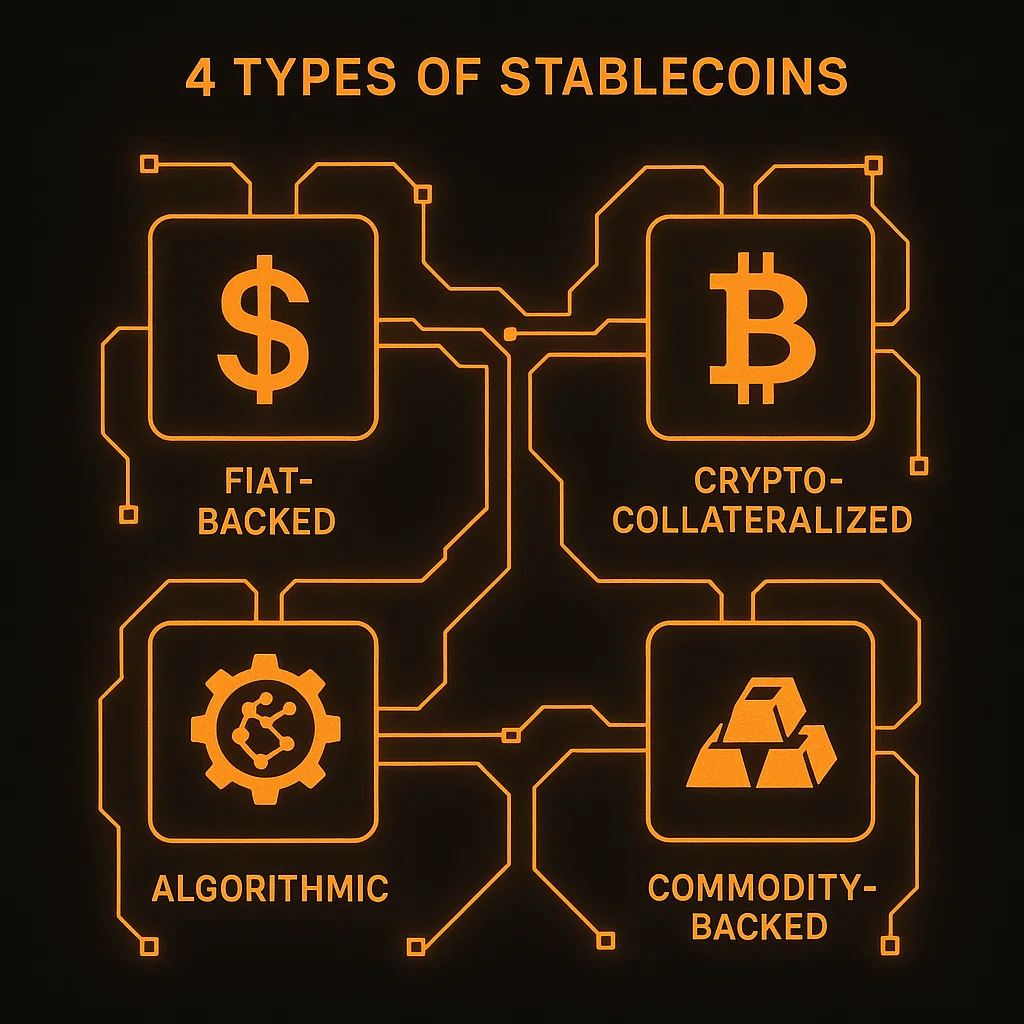
There are four main types of stablecoins, each using a unique mechanism to keep their price stable.To fully grasp how do stablecoins work, we need to explore what keeps their value consistent despite market volatility.
This guide breaks down the technical and economic principles behind the question how do stablecoins work, across various models and risk structures.
1. Fiat-Backed Stablecoins
These stablecoins are backed by real-world fiat currencies held in centralized reserves. Every token is redeemable 1:1 with fiat, such as USD or EUR.
- Examples: USDC (USD Coin), USDT (Tether)
- Mechanism: When supply exceeds demand and the price drops below $1, users buy the token and redeem it for fiat, reducing supply and restoring the peg.
- Risks: Depend on issuer trust, transparency, and regulatory compliance. Tether has faced repeated scrutiny for lack of clarity over reserves.
Fiat-backed stablecoins are the most popular due to their simplicity and direct pegging method.
2. Crypto-Collateralized Stablecoins
These are backed by other cryptocurrencies, such as ETH, and operate in a decentralized manner via smart contracts.
- Example: DAI by MakerDAO
- Mechanism: Users lock $150 worth of ETH to mint $100 of DAI. If ETH value drops, smart contracts trigger liquidations to protect the peg.
- Benefits: Transparency, on-chain governance, and non-custodial structure.
- Risks: Exposure to crypto volatility and smart contract bugs.
Crypto-backed stablecoins are preferred by decentralization advocates and DeFi developers.
3. Algorithmic Stablecoins
These use no collateral. Instead, their peg is maintained through code-based supply adjustments.
- Mechanism: If the price falls below $1, supply contracts; if it rises above, supply expands.
- Example: Frax, and formerly TerraUSD (UST).
- Risks: Extreme reliance on market confidence. TerraUSD collapsed in 2022 due to a loss of trust, causing billions in losses.
These coins are capital-efficient but extremely fragile during market stress.
4. Commodity-Backed Stablecoins
These coins are backed by physical assets like gold, offering commodity exposure with blockchain utility.
- Examples: Paxos Gold (PAXG), Tether Gold (XAUT)
- Mechanism: Each token represents a fractional ownership of a gold bar held in reserve.
- Benefits: Less volatile than crypto, real-world value backing.
- Risks: Asset redemption complexity, reliance on custodians.
These are useful for those seeking inflation hedges or diversifying portfolios with tangible assets.
Not sure what terms like over-collateralization, redemption, or algorithmic supply mean?
Check out our Blockchain Glossary to get clear definitions on key crypto concepts.
Mechanisms That Ensure Price Stability
Maintaining a stable peg is the most critical aspect of how stablecoins work. That’s why understanding how do stablecoins work under pressure especially during volatility is crucial for any crypto user. The main mechanisms include:
- Redemption and Arbitrage: Users buy undervalued tokens and redeem them at full price.
- Over-Collateralization: Extra collateral helps absorb price shocks in crypto-backed models.
- Elastic Supply: Algorithms adjust token circulation to restore peg.
- Market Confidence: All models depend on users believing the system works.
If confidence is lost, even the best-designed stablecoin can collapse.
Each mechanism provides a unique answer to the overarching question: how do stablecoins work when pressure hits the system?
Real-World Use Cases for Stablecoins
Stablecoins are already in use across multiple industries and use cases:
DeFi Protocols
Users provide liquidity, stake, or lend stablecoins on platforms like Aave and Compound to earn yield while avoiding volatility.
Ready to turn insights into action? Sign up to Bybit and get up to $30,050 in bonuses, including $50 free just for starting.
Cross-Border Payments
Stablecoins offer a cheaper, faster alternative to SWIFT transfers. Freelancers and businesses worldwide use them to bypass traditional banking rails.
On-Chain Commerce
Retailers are exploring stablecoin payments to reduce fees and settlement delays with companies like Walmart and Amazon testing integrations.
Dollarization in Emerging Economies
In countries with unstable currencies, citizens use stablecoins as dollar substitutes, storing wealth more securely than in local fiat.
Key Risks and Notable Events
Despite their “stable” label, these coins carry several risks:
Counterparty and Reserve Risk
Applies mainly to fiat-backed stablecoins. If an issuer like Tether fails to maintain reserves or transparency, it can result in depegging.
Ledger is the gold standard for hardware crypto wallets. Store your coins offline, safely. Explore Ledger
Smart Contract and Liquidation Risk
Relevant for crypto-backed coins like DAI. Bugs, attacks, or volatile collateral can lead to automatic liquidations or loss of funds.
Algorithmic Collapse
If an algorithm fails to stabilize the token, as happened with TerraUSD, the “death spiral” can lead to total failure and massive losses.
Regulatory Shifts
The recent GENIUS Act in the U.S. mandates that all stablecoin issuers must:
- Hold 100% liquid reserves
- Be licensed as financial institutions
- Submit to regular third-party audits
This increases user trust but also raises the bar for new projects.
Choosing the Right Stablecoin
Here’s how to decide which type suits your needs:
- Maximum reliability: Choose audited, fiat-backed coins like USDC.
- Decentralization: Use DAI or similar crypto-collateralized options.
- High capital efficiency: Only for experienced users algorithmic coins are risky.
- Real asset exposure: Gold-backed coins work well for wealth preservation.
Ultimately, choose based on your risk tolerance, goals, and how much you trust the issuing entity or protocol.
Conclusion
So, how do stablecoins work? In short, they leverage various models fiat reserves, crypto collateral, elastic supply, or commodity backing to stay pegged to a stable value. They are integral to the blockchain world, empowering secure transactions, borderless finance, and programmable money.
As regulation increases and institutional adoption grows, stablecoins are evolving from experimental tools into essential infrastructure.Understanding how do stablecoins work across different models gives users the confidence to navigate crypto safely and effectively.
Found this guide helpful? Support our mission by visiting our Donation Page every contribution helps us continue producing high-quality blockchain education for all.
Whether you’re a casual user, investor, or developer, understanding how stablecoins work helps you move with confidence in a decentralized economy.

Want more crypto knowledge? Join our newsletter for weekly insights, free guides, and tools.
What happens if a stablecoin issuer runs out of reserves?
The peg may break, causing depegging and losses. Regulations like the GENIUS Act aim to prevent this through audits and licensing.
Can crypto-backed stablecoins default?
Yes. If the collateral drops too sharply, smart contracts trigger liquidation, which can cause a partial or full loss of funds.
Why do algorithmic stablecoins often fail?
They rely heavily on market trust. If demand collapses, supply mechanisms can’t compensate, resulting in a death spiral.
Are stablecoins regulated?
Regulation is increasing. In the U.S., stablecoin issuers must comply with laws requiring full backing, audits, and institutional oversight.
Which stablecoin is the safest?
Fiat-backed coins like USDC, which undergo frequent audits and comply with financial regulations, are typically considered safest.
Guess what? When you click and buy via our links, you’re not just enhancing your experience you‘re also supporting our content creation for free, so we can keep sharing useful blockchain insights. It‘s a pump for both of us!
— Psycho