
Introduction to Decentralized Science
Decentralized Science (DeSci) is a new paradigm reshaping how we conduct, share, and fund scientific research. It leverages blockchain technology to create transparent, decentralized ecosystems where knowledge production and validation are open, verifiable, and community-governed. Through the use of smart contracts, token economies, and decentralized autonomous organizations (DAOs), DeSci eliminates traditional barriers in academia, such as limited access to data, centralized gatekeeping, and funding inequality.
This guide explores what is DeSci, how it functions, and why it offers a more efficient and equitable model compared to traditional systems. It also examines real-world applications and ongoing decentralized science projects, while offering insights into how anyone can participate in this movement.
What Is DeSci?
Decentralized Science refers to the application of blockchain technology to create an open and decentralized framework for scientific research. At its core, it replaces outdated academic structures with decentralized protocols that make research data, publications, funding, and peer review processes fully transparent and publicly accessible.
Why DeSci Emerged
DeSci emerged as a response to fundamental flaws in traditional academia:
- Limited access due to high paywalls
- Slow and non-transparent peer review
- Unequal distribution of research funding
- Data manipulation and lack of reproducibility
In contrast, DeSci vs traditional science highlights a shift from centralized control to community ownership, trustless validation, and permissionless innovation.
If you’re new to Web3 terminology, feel free to consult our Blockchain Glossary to explore key concepts like DAOs, smart contracts, and tokenomics.
Core Components of the DeSci Ecosystem
Blockchain for Scientific Research
Public blockchains like Ethereum, Arweave, and Polygon act as the foundation for Decentralized Science. They ensure data integrity by timestamping research logs, peer reviews, funding decisions, and final publications. These ledgers are immutable and publicly verifiable, removing the possibility of tampering or data loss.
Smart Contracts and Open Access Protocols
Smart contracts are used to automate critical actions such as:
- Disbursing grants once research milestones are met
- Verifying peer reviews
- Publishing results automatically
Protocols like IPFS, Arweave, and Ceramic are used to store open-access research papers, datasets, and metadata.
Token Incentives and DeSci Crypto Tokens
Platforms issue DeSci crypto tokens to reward contributions and align incentives. Researchers, reviewers, and contributors earn tokens for:
- Publishing results
- Reviewing others’ work
- Contributing to governance
Tokens often grant voting rights within DAOs, allowing for decentralized decision-making.
For more, see our post on What Are DAOs and How Do They Work.
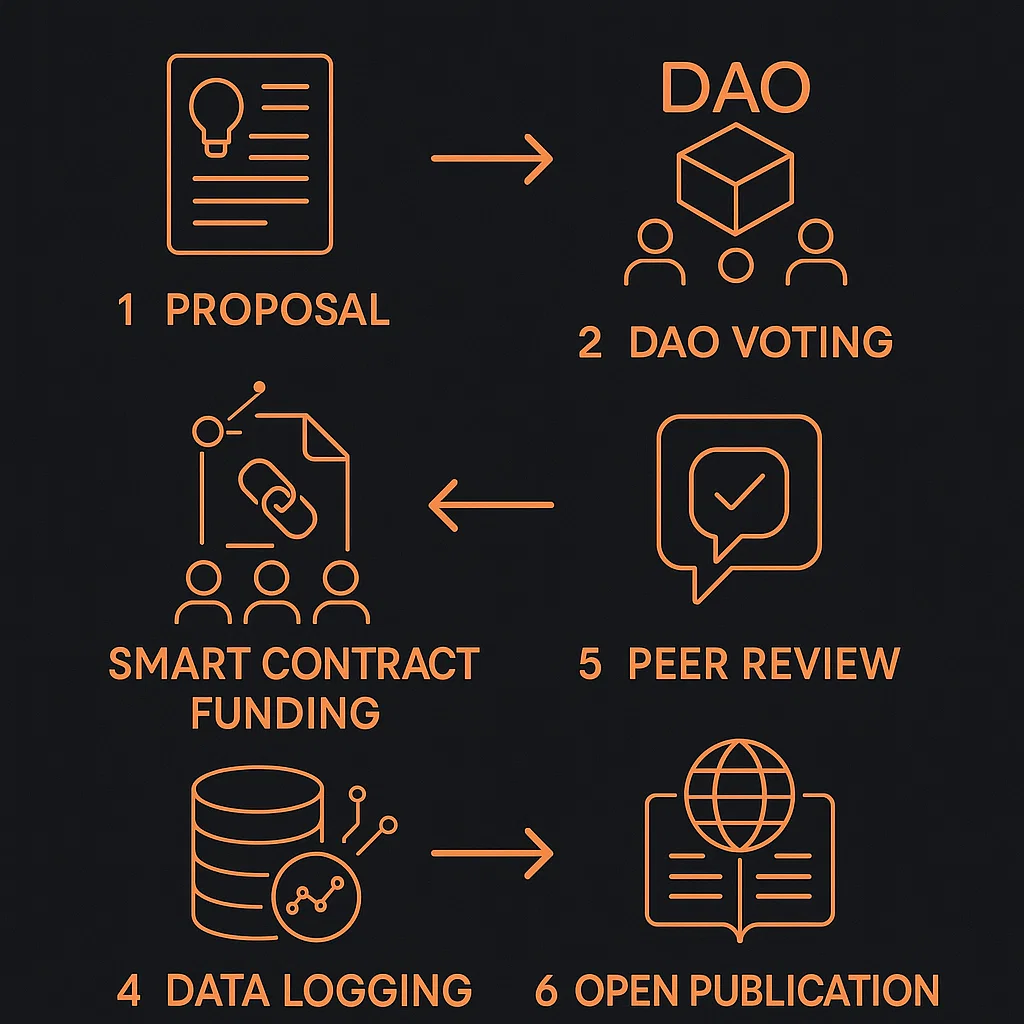
How DeSci Works: Step-by-Step
Understanding how DeSci works is key to grasping its transformative potential:
- A researcher submits a proposal to a DeSci platform.
- DAO members vote on whether to fund the proposal.
- If approved, smart contracts release funding via tokens or stablecoins.
- Research logs, data, and results are published on-chain or via decentralized storage.
- Peer reviewers from the community validate findings.
- Reviewers earn token incentives for their contributions.
- Final outputs are published under open licenses, permanently accessible.
Every action is timestamped, verifiable, and traceable, ensuring maximum transparency and reproducibility.
Benefits of Decentralized Science
Transparency and Trust
Each phase of the scientific process from funding to publication is recorded on-chain. This ensures there is no room for hidden changes, data manipulation, or closed-door reviews.
Faster, Community-Led Peer Review
Traditional peer review takes months. In DeSci ecosystems, community validators assess work in real-time, reducing turnaround from months to days or weeks.
If you’d like to support open research initiatives, consider contributing via our donations page.
Open Access and Inclusive Funding
Blockchain for scientific research breaks down barriers:
- No more paywalls
- Access for independent and underfunded researchers
- Global participation without institutional affiliation
This democratized model increases diversity and drives innovation.
Real-World Decentralized Science Projects
VitaDAO
One of the leading decentralized science projects, VitaDAO funds longevity and biomedicine research. Token holders collectively vote on proposals, disburse funding, and receive ownership rights to research outcomes.
OpenLabDAO
Focuses on early-career scientists and projects that struggle to secure traditional funding. OpenLabDAO enables rapid grant decisions and peer collaboration via tokenized governance.
ScienceDAO
Reimagines peer review and publishing. Scientists upload preprints, get community validation, and earn tokens for contributing. All data is stored on decentralized networks.
If you’re curious about other top initiatives, check out Top Crypto Projects With Real-World Use Cases.
Challenges and Risks in DeSci
Legal and Regulatory Barriers
Tokenized grant systems may trigger securities regulation. Platforms must be cautious about legal classification of DeSci crypto tokens.
Data Privacy and Off-Chain Handling
Sensitive information such as medical trial data cannot be fully public. DeSci solutions must integrate encrypted storage and privacy-preserving protocols.
UX, Accessibility, and Scaling
Blockchain complexity may alienate non-technical users. Also, high gas fees and slow transaction speeds can hinder adoption, although Layer 2 solutions are helping.
Quality Control and Reputation
Without traditional editorial boards, DeSci relies on decentralized reputation systems and stake-based voting to maintain scientific standards.
How to Get Involved in DeSci
You don’t have to be a PhD to contribute to Decentralized Science:
- Join a DAO like VitaDAO, OpenLabDAO, or ScienceDAO
- Propose or fund a research project
- Review papers and earn rewards
- Participate in governance via token votes
- Publish on decentralized platforms (e.g. IPFS, Arweave)
This is open science for the Web3 era.
Future of Decentralized Science (2025 and Beyond)
By 2025, DeSci is expected to integrate more deeply with adjacent Web3 innovations. NFT-based authorship, decentralized ID systems, and cross-chain collaborations will enhance interoperability.
Funding will evolve too. DeFi protocols could allocate pooled capital toward research grants, creating decentralized versions of institutional endowments. For example, DAOs could set up bonding curves to support recurring scientific income.
Public institutions and even governments may begin collaborating with blockchain for scientific research to ensure integrity, track grant efficiency, and eliminate corruption.
Key intersections will include:
- How Blockchain Is Revolutionizing Intellectual Property: NFTs and on-chain data ownership tools will redefine who owns and profits from scientific work.
- Partnerships with AI tools to analyze decentralized datasets and improve knowledge discovery.
- DAO-to-DAO collaborations to solve global problems collectively.
Conclusion
Decentralized Science is not just an upgrade it’s a revolution in how we do science. It offers transparency, open access, faster validation, and community-driven innovation. As the ecosystem matures, DeSci may reshape global research infrastructure from the ground up.
Whether you’re a researcher, investor, student, or enthusiast, now is the time to explore and contribute to this movement. The future of science is open, transparent, and on-chain.
Want to stay ahead of the DeSci revolution?
Subscribe to the BlockchainDudes newsletter for weekly insights, tools, and real-world crypto use cases direct to your inbox.
What Is DeSci?
DeSci uses blockchain and token incentives to make every step transparent, verifiable, and community‑driven in contrast to closed journals, delayed peer review, and gated funding.
How do researchers get paid in DeSci platforms?
Funding is distributed via smart contracts using tokens (stablecoins or governance tokens) through DAO‑approved grants; reviewers and contributors are also rewarded on chain.
Is DeSci suitable for clinical or sensitive human data research?
Sensitive data must usually be stored off‑chain with careful privacy protections. Ethical review remains essential, and only metadata or hashes may live on chain.
What are the risks of token-based DeSci?
Regulatory scrutiny (e.g. token as unregistered security), protocol hacks, on‑chain fee costs, and governance vulnerability are key concerns.
Can students or independent researchers join DeSci communities?
Absolutely. DeSci is built to be inclusive students, citizen scientists, and unaffiliated researchers can propose ideas, join DAOs, contribute to reviews, and earn rewards.
Guess what? When you click and buy via our links, you’re not just enhancing your experience you‘re also supporting our content creation for free, so we can keep sharing useful blockchain insights. It‘s a pump for both of us!
— Black