


If you’re a developer, understanding blockchain protocols isn’t just optional anymore it’s essential. As blockchain technology continues to disrupt industries from finance to healthcare, developers are increasingly expected to have a solid grasp of how different protocols work. Whether you’re building decentralized applications (dApps), integrating blockchain into an existing project, or just curious about the technology, knowing the ins and outs of blockchain protocols will set you apart in the field.
At its core, blockchain is a distributed ledger technology that facilitates secure, transparent, and tamper-proof transactions. From cryptocurrencies like Bitcoin to platforms for smart contracts and decentralized finance (DeFi), blockchain applications are as varied as they are transformative. But to unlock its full potential as a developer, you need to start with the basics: understanding blockchain protocols.
In this blog, we’ll explore the must-know blockchain protocols for developers. We’ll break down what protocols are, why they matter, and dive into the specific protocols shaping the industry today. Let’s get started.
What Are Blockchain Protocols?
Let’s begin with the fundamentals. Blockchain protocols are essentially the rules that govern how a blockchain operates. Think of them as the backbone of any blockchain system, defining how data is validated, how participants interact, and how security is maintained.
These protocols are critical to the blockchain ecosystem for several reasons. First, they establish trust in a decentralized network by ensuring that all participants agree on the state of the ledger. Second, they dictate the network’s performance, including transaction speed, scalability, and security. Without protocols, the blockchain would simply be an unorganized collection of nodes with no way to achieve consensus.
The most talked-about attributes of blockchain protocols are security, scalability, and decentralization. These three pillars form what is often called the Blockchain Trilemma the idea that achieving all three simultaneously is extremely challenging. While some protocols prioritize security (like Bitcoin), others focus on scalability or decentralization to support specific use cases.
For developers, understanding these attributes is crucial. Each protocol has its strengths and weaknesses, and the right choice depends on the requirements of your project. Whether you’re building a high-speed trading platform or a decentralized voting system, the protocol you choose will have a significant impact on your application’s success.
Why Developers Should Care About Blockchain Protocols
If you’re wondering why blockchain protocols matter so much for developers, the answer is simple: they determine how your application functions. From transaction processing to network fees, protocols impact almost every aspect of blockchain-based development.
One major reason developers need to pay attention to protocols is scalability. Imagine you’re developing a decentralized app that needs to handle thousands of transactions per second. Choosing a protocol like Solana, known for its high throughput, could make or break your project. Conversely, if you’re building an application focused on security and immutability, Bitcoin might be a better fit.
Another factor is the functionality enabled by the protocol. For instance, Ethereum’s protocol supports smart contracts, allowing developers to build complex, self-executing agreements. This has opened the door to a wide range of applications, from DeFi platforms to NFTs. Similarly, Polkadot’s focus on interoperability makes it ideal for projects requiring communication between different blockchains.
Developers should also consider industry demand. Blockchain-savvy developers are in high demand, with companies looking for expertise in protocols like Ethereum, Binance Smart Chain, and Cardano. By familiarizing yourself with these protocols, you’re not just expanding your technical skillset you’re also boosting your career prospects.
Ultimately, understanding blockchain protocols allows developers to build better, more efficient applications. It ensures that your project aligns with the technical capabilities and constraints of the chosen protocol, setting the stage for long-term success.
Key Blockchain Protocols Developers Should Know
Now that we’ve covered why blockchain protocols matter, let’s dive into some of the most influential protocols that developers should be familiar with. Each of these has unique features and use cases, making them valuable tools in your blockchain development toolkit.
Bitcoin (BTC)
Bitcoin is where it all began. Launched in 2009, Bitcoin’s protocol introduced the concept of a decentralized digital currency powered by a proof-of-work (PoW) consensus mechanism. This protocol focuses on security and immutability, making it the go-to choice for applications requiring a rock-solid foundation.
While Bitcoin isn’t as versatile as newer protocols, it still offers opportunities for developers. For example, the Lightning Network, a second-layer solution, allows developers to create applications with faster and cheaper Bitcoin transactions. If your project involves digital payments or asset transfers, understanding Bitcoin’s protocol is a must.
If you’re looking to secure your Bitcoin and other crypto assets, consider using a hardware wallet like Ledger. Ledger provides the most secure way to store your cryptocurrencies offline, keeping them safe from online threats. Buy your Ledger now here and protect your digital assets today!
Ethereum (ETH)
Ethereum is often called the “world computer” of blockchain. Introduced in 2015, it expanded the possibilities of blockchain with its support for smart contracts and the Ethereum Virtual Machine (EVM). These features make Ethereum the backbone of DeFi, NFTs, and countless dApps.
For developers, Ethereum’s flexibility is a game-changer. You can write smart contracts in languages like Solidity, deploy them on the network, and interact with them through dApps. However, it’s worth noting that Ethereum’s scalability issues and high gas fees have led to the rise of alternatives like Binance Smart Chain and Polygon.
For those looking to explore crypto trading, Bybit offers an exclusive deal. When you sign up through my referral, you’ll get access to up to $30,050 in Welcome Rewards, including a $50 sign-up bonus and VIP trading perks. Plus, you’ll gain an exclusive “Supporter” role in my Discord server, where you can join discussions about blockchain development. Sign up for Bybit here to get started!
Binance Smart Chain (BSC)
Binance Smart Chain is a relative newcomer but has quickly gained popularity due to its compatibility with Ethereum’s EVM and its lower transaction fees. BSC uses a proof-of-staked-authority (PoSA) consensus mechanism, which allows for faster and cheaper transactions compared to Ethereum.
More about binance smart chain protocol
For developers, BSC offers a familiar environment for those already experienced with Ethereum. It’s particularly appealing for projects targeting cost-sensitive users or those looking to scale quickly. Popular applications on BSC include decentralized exchanges, gaming platforms, and yield farming protocols.
Polkadot (DOT)
Polkadot takes a unique approach with its multi-chain architecture, enabling interoperability between blockchains. Its protocol is built around parachains individual blockchains that run parallel to the main chain. This design allows Polkadot to achieve scalability and flexibility that few other protocols can match.
For developers, Polkadot is an excellent choice for projects requiring cross-chain communication. Whether you’re building a DeFi platform that interacts with multiple blockchains or a custom blockchain for a specific use case, Polkadot’s protocol provides the tools you need to succeed.
Cardano (ADA)
Cardano stands out for its emphasis on sustainability and scalability. Its layered architecture separates the settlement layer (used for transactions) from the computation layer (used for smart contracts), making it highly efficient. Cardano’s protocol is based on proof-of-stake (PoS), which is more energy-efficient than Bitcoin’s proof-of-work.
Developers are drawn to Cardano for its rigorous approach to research and development. The protocol is built on peer-reviewed academic research, ensuring a strong theoretical foundation. This makes it an attractive choice for applications requiring high reliability, such as supply chain tracking or educational platforms.
Solana (SOL)
Solana has made a name for itself as one of the fastest blockchains in the world, capable of handling tens of thousands of transactions per second. Its proof-of-history (PoH) consensus mechanism is a key innovation, enabling rapid transaction processing without sacrificing security.
For developers, Solana is ideal for applications requiring high throughput, such as gaming, DeFi, and real-time data analysis. Its low transaction fees and robust ecosystem make it a strong contender for projects looking to scale quickly.
Avalanche (AVAX)
Avalanche is designed for speed and versatility, supporting custom blockchain deployments and decentralized applications. Its consensus mechanism, Avalanche, allows for sub-second transaction finality, making it one of the fastest protocols available.
Avalanche’s ecosystem is particularly appealing for DeFi projects, thanks to its support for Ethereum-compatible smart contracts and tools. Developers can create custom blockchains tailored to specific use cases, making Avalanche a flexible choice for innovative projects.
Emerging Blockchain Protocols to Watch
While established protocols like Bitcoin and Ethereum dominate the market, several emerging protocols are worth keeping an eye on. These newer platforms are pushing the boundaries of what blockchain technology can achieve.
Tezos
Tezos is a self-amending blockchain designed for sustainability. Its on-chain governance system allows stakeholders to vote on protocol upgrades, reducing the risk of hard forks. This makes it an excellent choice for projects requiring long-term stability and adaptability.
Algorand
Algorand focuses on speed and scalability, using a pure proof-of-stake (PPoS) consensus mechanism. Transactions on Algorand are finalized in seconds, making it ideal for applications like payment systems and digital asset exchanges.
Near Protocol
Near Protocol is a developer-friendly blockchain that prioritizes usability. Its sharding technology enables scalability, while its tools and documentation make it accessible for developers of all skill levels. Near is particularly appealing for building decentralized applications quickly and efficiently.
Comparing Blockchain Protocols
With so many protocols available, choosing the right one for your project can be daunting. Here’s a quick comparison of key attributes:
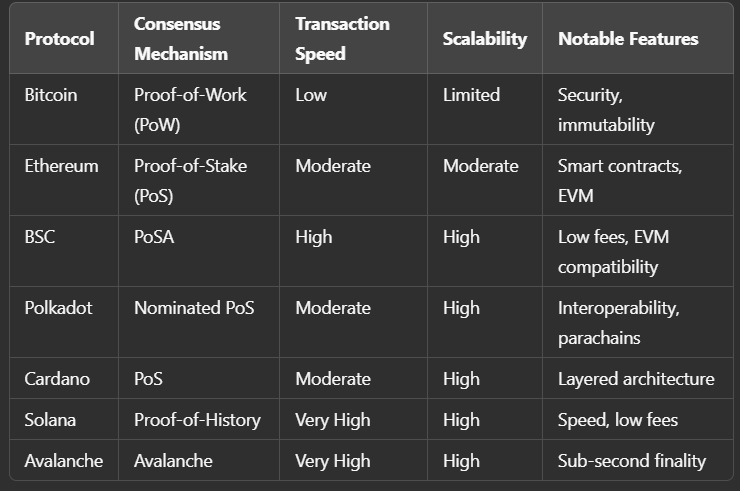
Evaluating the right protocol involves considering factors like transaction speed, scalability, and specific project needs. Taking the time to analyze these attributes will help ensure your project’s success.
Challenges in Developing on Blockchain Protocols
Developing on blockchain protocols isn’t without its challenges. Scalability issues, security concerns, and the complexity of blockchain technology can pose significant hurdles. However, there are ways to overcome these challenges:
- Start Small: Begin with smaller projects to gain experience and understand the nuances of blockchain development.
- Leverage Tools: Use development frameworks like Truffle, Hardhat, and Remix to streamline the process.
- Stay Updated: Blockchain is a fast-evolving field. Keeping up with protocol updates and industry trends is crucial.
By addressing these challenges head-on, developers can unlock the full potential of blockchain technology.
Tools and Resources for Blockchain Development
To succeed in blockchain development, you need the right tools and resources. Here are some essentials:
- Frameworks: Truffle, Hardhat, and Remix are popular tools for developing and testing smart contracts.
- Documentation: Protocol-specific documentation is invaluable for understanding how to build on platforms like Ethereum or Polkadot.
- Communities: Join forums and online groups to connect with other developers and gain insights.
Investing time in learning and experimenting with these tools will set you up for success in the blockchain space.
The Future of Blockchain Protocols
The blockchain landscape is constantly evolving, with new protocols and innovations emerging regularly. Trends like interoperability, improved scalability, and energy efficiency are shaping the future of blockchain protocols.
As developers, staying ahead of these trends will enable you to create cutting-edge applications and contribute to the growth of blockchain technology. The next generation of protocols promises to be even more powerful and versatile, paving the way for broader adoption across industries.
Conclusion
Blockchain protocols are the foundation of this transformative technology, and understanding them is essential for developers. From Bitcoin’s security to Solana’s speed, each protocol offers unique advantages and opportunities.
As you continue your journey in blockchain development, take the time to explore and experiment with different protocols. Engage with the community, stay informed about the latest trends, and never stop learning. The blockchain revolution is just beginning, and as a developer, you have the power to shape its future.
FAQs
What are the most beginner-friendly blockchain protocols for developers?
Ethereum and Binance Smart Chain are great starting points due to their extensive documentation and large developer communities.
How do I choose the right blockchain protocol for my project?
Consider factors like transaction speed, scalability, and the specific features required for your application.
Are there free resources to learn blockchain development?
Yes, platforms like FreeCodeCamp, Solidity documentation, and developer forums offer valuable resources at no cost.
What’s the difference between Bitcoin and Ethereum protocols?
Bitcoin focuses on security and immutability, while Ethereum supports smart contracts and decentralized applications.
How is interoperability impacting blockchain development?
Interoperability allows blockchains to communicate with each other, enabling more complex and connected decentralized ecosystems.
“Guess what? When you click and buy through our links, you’re doing more than improving your journey. You’re supporting us in a way that doesn’t cost you extra but helps us keep bringing you the best blockchain posts. It’s a pump for both of us!”
-0xteumessia