What Is Chainlink VRF?
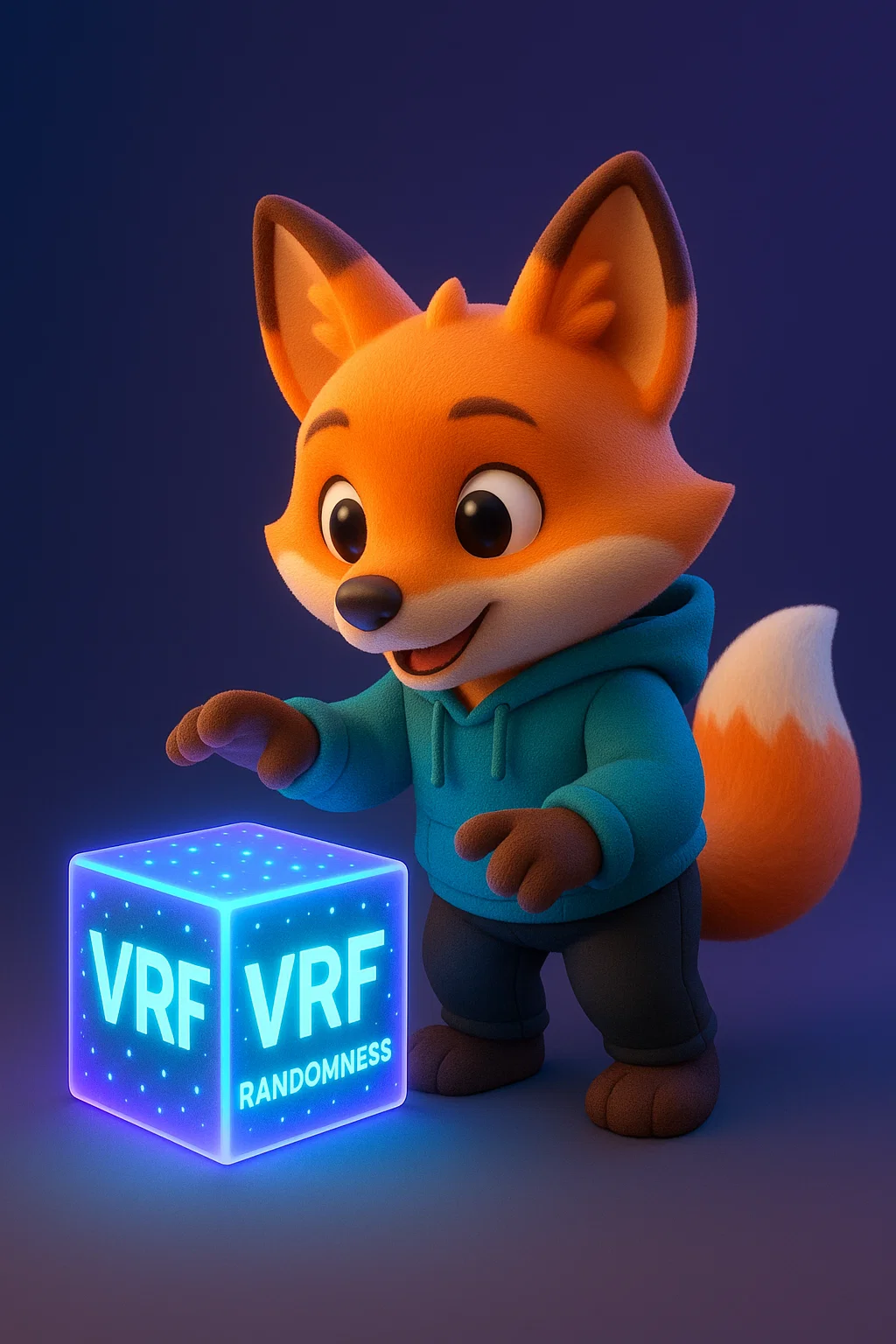
Chainlink VRF (Verifiable Random Function) is a decentralized oracle-based solution that provides secure, verifiably fair randomness to blockchain applications. In a decentralized system where transparency, security, and trust are non-negotiable, randomness must be both unpredictable and provable two requirements that Chainlink VRF fulfills.
Unlike traditional random number generators (RNGs) which rely on internal computation or potentially biased sources, Chainlink VRF allows smart contracts to access random values that come with cryptographic proof, ensuring that the result is truly random and has not been tampered with by any party including the node providing the data.
Why Secure Randomness Matters in Web3
Randomness is a fundamental building block for many decentralized applications (dApps). In gaming, lotteries, NFT drops, or randomized governance, the lack of verifiable randomness could lead to exploits, loss of trust, or centralization risks.
Unfair Randomness Can Break Trust
In Web2, developers often rely on pseudorandom number generators (PRNGs), which can be sufficient in centralized environments. However, in blockchain, everything is transparent and deterministic making typical methods (e.g., using block hashes or timestamps) easily exploitable.
Chainlink VRF replaces this vulnerability with a provably fair solution that anyone can audit, fostering confidence in fair play, equal opportunity, and decentralized integrity.
How Chainlink VRF Works
Request and Fulfillment Process
- A smart contract sends a request for randomness to the VRF Coordinator contract.
- The request includes a user-provided seed, a subscription ID, and a gas lane (keyHash).
- A Chainlink oracle node receives the request and generates:
- A random value.
- A cryptographic proof tied to its private key and the seed.
- Both the value and proof are sent back on-chain.
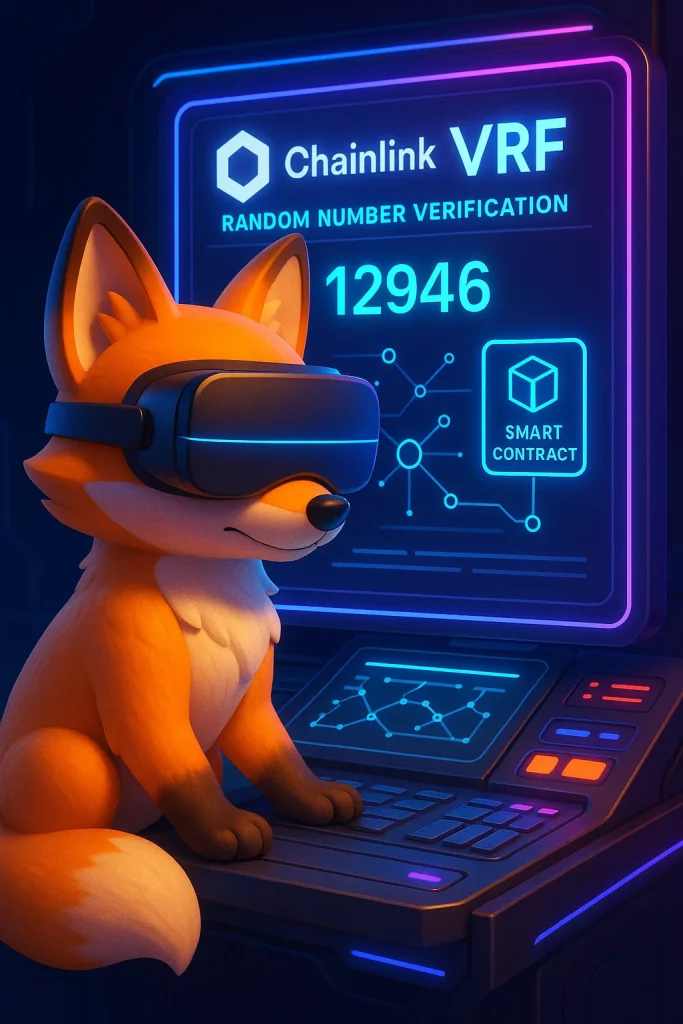
- The contract runs a verification algorithm to confirm the validity of the proof.
- If verified, the randomness is accepted and used.
This process ensures no manipulation, predictability, or backdoors—which is essential for applications requiring impartial outcomes.
Use Cases of Chainlink VRF
1. NFT Randomization
NFT projects use Chainlink VRF to assign traits, metadata, or rarity tiers after minting. This prevents users from selectively minting only rare items. Instead, everyone has an equal chance, creating fairness and driving engagement.
2. Blockchain Gaming
Game developers rely on secure randomness to determine loot drops, card shuffles, or battle outcomes. Without tamper-proof randomness, players could accuse the platform of rigging results. Chainlink VRF integrates trust directly into the gameplay logic.
3. Decentralized Lotteries and Raffles
Lottery platforms use Chainlink VRF to pick winners on-chain and publicly verifiable. This eliminates the need to trust any intermediary or back-end script—ensuring the system cannot be gamed by insiders or miners.
4. DAO Governance & DeFi Systems
Some Decentralized Autonomous Organizations (DAOs) use Chainlink VRF in voting systems, airdrop eligibility, or staker selection, providing secure randomness that maintains decentralization and reduces voter manipulation.
Chainlink VRF vs. Other Solutions
Problems With Other Randomness Methods
- Block hashes or timestamps: easily manipulated by miners.
- Off-chain RNG: not auditable, introduces centralization risks.
- User input mixing: can be front-run or reverse engineered.
Advantages of Chainlink VRF
- On-chain verification of randomness.
- Decentralized oracle nodes.
- Cryptographic proofs tied to verifiable inputs.
- Tamper-resistance and public transparency.
This is why Chainlink VRF is considered the gold standard in Web3 randomness.
What’s New in Chainlink VRF v2
The release of Chainlink VRF v2 introduced critical improvements:
- Subscription funding: no need to send LINK with every request.
- Batch randomness requests: allows for requesting multiple numbers in one call.
- Lower gas costs: optimized for cheaper transactions.
- Greater scalability: suitable for high-throughput dApps.
These upgrades make Chainlink VRF even more accessible for developers launching large-scale blockchain games or automated systems.
“Ledger is the gold standard for hardware crypto wallets. Store your coins offline, safely.”
Integrating Chainlink VRF: Developer Guide
Quick Steps to Get Started
- Set up a Chainlink subscription and get your subscription ID.
- Choose the appropriate keyHash for your blockchain.
- Implement the
fulfillRandomWordscallback in your smart contract. - Call the
requestRandomWords()function with the correct parameters.
Chainlink provides clear documentation, test environments, and example contracts that make this integration easy, even for developers new to cryptographic systems.
Costs and Optimizations
Transaction Fees
Each randomness request on Ethereum Mainnet may cost $5–$20 in gas fees, depending on network conditions. This includes the request and the fulfillment callback. Projects with limited budgets can:
- Use Layer 2 solutions like Polygon or Arbitrum.
- Batch multiple requests into one.
- Optimize callback logic to minimize computation.
Despite the cost, many developers find the security guarantees well worth the investment.
“Want more crypto knowledge? Join our newsletter for weekly insights, free guides, and tools.”
Security Best Practices
To ensure full protection, developers should:
- Restrict function access: only the VRF Coordinator should be able to call your fulfill function.
- Validate the proof before using the random value.
- Use testnets to simulate and verify behavior before mainnet deployment.
- Monitor subscription balances to avoid failed requests.
Following these best practices is crucial for avoiding logic flaws or security gaps in live deployments.
The Future of Chainlink VRF
Chainlink Labs continues to innovate on VRF technology. Future improvements may include:
- Threshold cryptography: enabling multi-party randomness generation.
- Privacy-preserving randomness: for confidential auctions or private games.
- Cross-chain VRF: supporting randomness across Layer 1 and Layer 2 networks.
As demand for secure randomness grows in the Web3 ecosystem, Chainlink VRF is set to remain the industry leader in this critical infrastructure layer.
Conclusion
Chainlink VRF is a powerful, secure, and verifiable solution for generating randomness in smart contracts. It enables fairness, transparency, and trust across a wide range of dApps—especially in sectors like NFTs, gaming, lotteries, and DeFi.
Thanks to its decentralized architecture and on-chain verifiability, Chainlink VRF protects developers and users alike from manipulation and exploitation. With the release of VRF v2, it’s now more scalable, affordable, and developer-friendly than ever before.
Whether you’re launching the next big blockchain game, a revolutionary NFT project, or a secure lottery platform—Chainlink VRF provides the trusted randomness your project needs to succeed.
Type / to choose a
What is the difference between Chainlink VRF v1 and v2?
VRF v2 introduces a subscription system, lower gas costs per request, and support for multi-word randomness output, improving scalability and developer flexibility.
How much does a VRF request cost?
Costs depend on network gas and LINK price but typically range from $5 to $20 per random response—batching and optimizing gas can lower per-use expenses.
Can Chainlink VRF be predicted by anyone?
No each random number comes with a cryptographic proof that’s verified on-chain, ensuring the output wasn’t tampered with before delivery.
Which blockchains support Chainlink VRF?
VRF is available on Ethereum, Polygon, BNB Chain, Avalanche, Fantom, Arbitrum, and other major chains.
Do I need to run a VRF node to use the service?
No as a developer, you simply configure your contract and subscription. Chainlink nodes handle the randomness generation and proof process.
“Guess what? When you click and buy via our links, you’re not just enhancing your experience—you‘re also supporting our content creation for free, so we can keep sharing useful blockchain insights. It‘s a pump for both of us!”
— Edo