
Why Layer 2 Scaling Solutions Matter in 2025
As blockchain adoption accelerates across industries from DeFi and gaming to digital identity and real-time finance scaling becomes more than a technical challenge. It’s a necessity. This is where Layer 2 Scaling Solutions come into play. They are no longer optional add-ons but essential components of a performant, secure, and accessible Web3 infrastructure.
More than just a performance enhancer, Layer 2 Scaling Solutions are shaping the future of decentralized applications across Ethereum and beyond.
By 2025, demand for efficient transaction processing has skyrocketed, especially on congested Layer 1 networks like Ethereum. This has fueled a boom in Layer 2 development. But to truly understand their role, we first need to answer a common question: what are Layer 2 solutions?
What Are Layer 2 Solutions?
Layer 2 solutions are secondary protocols built on top of base-layer blockchains such as Ethereum. Their purpose is to offload transaction volume from the main chain, enabling faster throughput and lower costs without compromising decentralization or security.
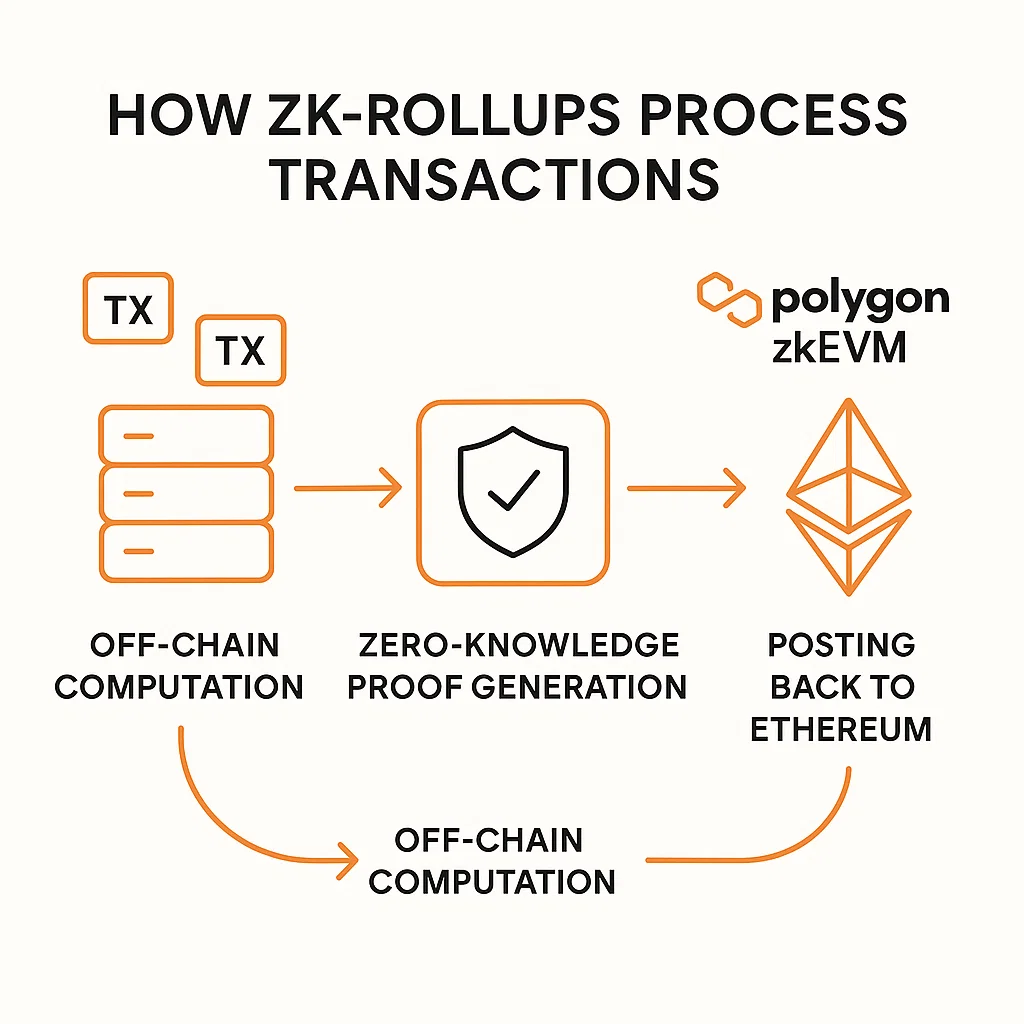
Instead of having every transaction verified directly on Layer 1, Layer 2 processes them off-chain or in parallel, and then posts a summary or proof back to the mainnet. This structure dramatically improves blockchain scalability and efficiency.
If you’re just getting started with blockchain technology, we recommend reading: Ethereum Explained: The Basics of the Blockchain Platform.
This makes Layer 2 Scaling Solutions a key enabler for reducing congestion and expanding real-world blockchain use cases.
Layer 2 vs Layer 1: Key Differences
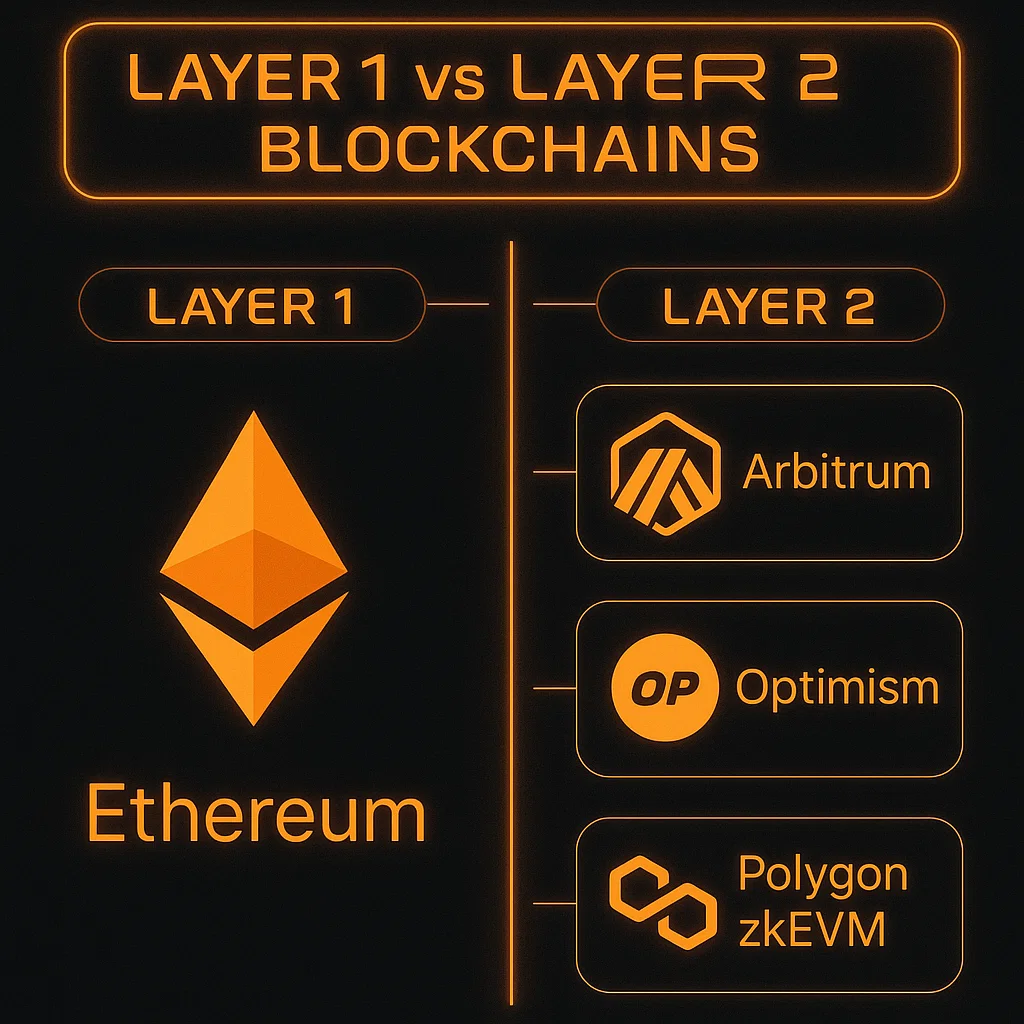
Understanding the difference between Layer 2 vs Layer 1 is crucial. Layer 1 refers to the base blockchain protocol Ethereum, Bitcoin, Solana where all transactions are processed on-chain. This ensures trust and immutability but limits speed and affordability.
By contrast, Layer 2 Scaling Solutions reduce the load on Layer 1 by processing transactions elsewhere and periodically syncing results. This architecture enables higher transaction per second (TPS) rates, drastically reduced gas fees, and a smoother user experience ideal for mass adoption.
Benefits of Layer 2 Scaling
There are several compelling benefits of Layer 2 scaling, including:
- Lower Fees: Transaction costs drop from dollars to cents or less. This removes a major barrier for new users and developers.
- Higher Throughput: Many Layer 2s can handle thousands of TPS, far exceeding Layer 1 capabilities.
- Faster Confirmations: Transactions are confirmed in seconds, enabling smooth real-time dApp usage.
- User-Friendly dApps: Lower costs and better UX make complex applications more accessible to non-technical users.
- Greater Accessibility: Technologies like zk-rollups make micro-payments, NFT minting, and DeFi swaps viable at scale.
These benefits make Layer 2 Scaling Solutions critical for onboarding the next billion users into Web3 environments.
For deeper insights into transaction costs, don’t miss: Understanding Ethereum Gas Fees: A Comprehensive Guide.
Layer 2 Blockchain Examples Dominating 2025
Let’s explore real-world layer 2 blockchain examples that lead the ecosystem in 2025. These platforms demonstrate how scalable infrastructure enables new business models and user experiences.
Several Layer 2 Scaling Solutions have emerged as industry leaders, each optimized for different use cases.
Arbitrum – Optimistic Rollup PerformanceArbitrum remains one of the best Layer 2 projects 2025, known for its Optimistic Rollup approach. It processes roughly 4,000 TPS, with average confirmation times between 1 to 2 minutes and transaction fees as low as $0.10. It’s widely adopted in DeFi protocols, DAOs, and NFT marketplaces.
To learn how DeFi is evolving on rollups like Arbitrum, see: How Decentralized Finance (DeFi) is Evolving in 2025.
Optimism – Infrastructure and Governance Pioneer
Another top player is Optimism, which also uses the Optimistic Rollups model. With ~2,500 TPS, fast finality, and deep Ethereum integration, it’s favored for public goods funding, DAO tooling, and infrastructure projects. Developers love Optimism’s clear roadmap and focus on governance.
If you’re curious about how this rollup structure works, here’s a quick explanation: optimistic rollups explained they assume transactions are valid by default and allow a short period to dispute fraudulent data. This reduces overhead compared to cryptographic proofs used in zk-rollups.
Polygon zkEVM – Zero-Knowledge Rollup Power
Polygon zkEVM leverages zero-knowledge proofs to achieve ultra-high scalability. With up to 20,000 TPS, near-instant confirmation (10–30 seconds), and low gas fees, it supports complex smart contracts and Web3 gaming with ease. Plus, it’s fully compatible with existing Ethereum tools.
When comparing architectures, one key debate arises: zk-rollups vs optimistic rollups. While optimistic rollups are simpler to implement, zk-rollups offer stronger security guarantees and instant finality. Polygon zkEVM sits at the cutting edge of this technology.
StarkNet – STARK-Proof Computation
StarkNet uses STARKs (Scalable Transparent Arguments of Knowledge), a type of zero-knowledge proof, to power next-gen applications. It supports ~10,000 TPS and is ideal for dApps with high on-chain computation needs, such as machine learning models or recursive logic.
Its design focuses on trustless scalability and deep modularity, making it ideal for advanced developers who want full control over execution.
Base by Coinbase – Mass Adoption at Scale
Coinbase’s Base chain has exploded in popularity, now handling over 40% of all Ethereum Layer 2 volume. With billions in total value locked (TVL), low transaction fees, and direct fiat onramps via Coinbase, Base is fast becoming the go-to option for enterprises and mainstream users alike.
It’s a practical Layer 2 choice for those prioritizing adoption, liquidity, and ecosystem reach.
ZKsync, Loopring, Mantle – Specialized L2 Options
Other best Layer 2 projects 2025 include:
- ZKsync: Optimized for fast payments and NFT minting, with strong developer tools.
- Loopring: Focused on decentralized exchanges (DEXs), offering gasless trades and liquidity optimization.
- Mantle: A gaming-focused Layer 2 with blazing-fast block times (~10ms) and microtransaction support.
These platforms highlight the diversity of Layer 2 use cases beyond just DeFi and NFTs.
Advancements Fueling Layer 2 Growth in 2025
The evolution of Layer 2 Scaling Solutions isn’t static. Several technological and governance innovations are reshaping the ecosystem.
Decentralized Sequencers & Cross-Chain Messaging
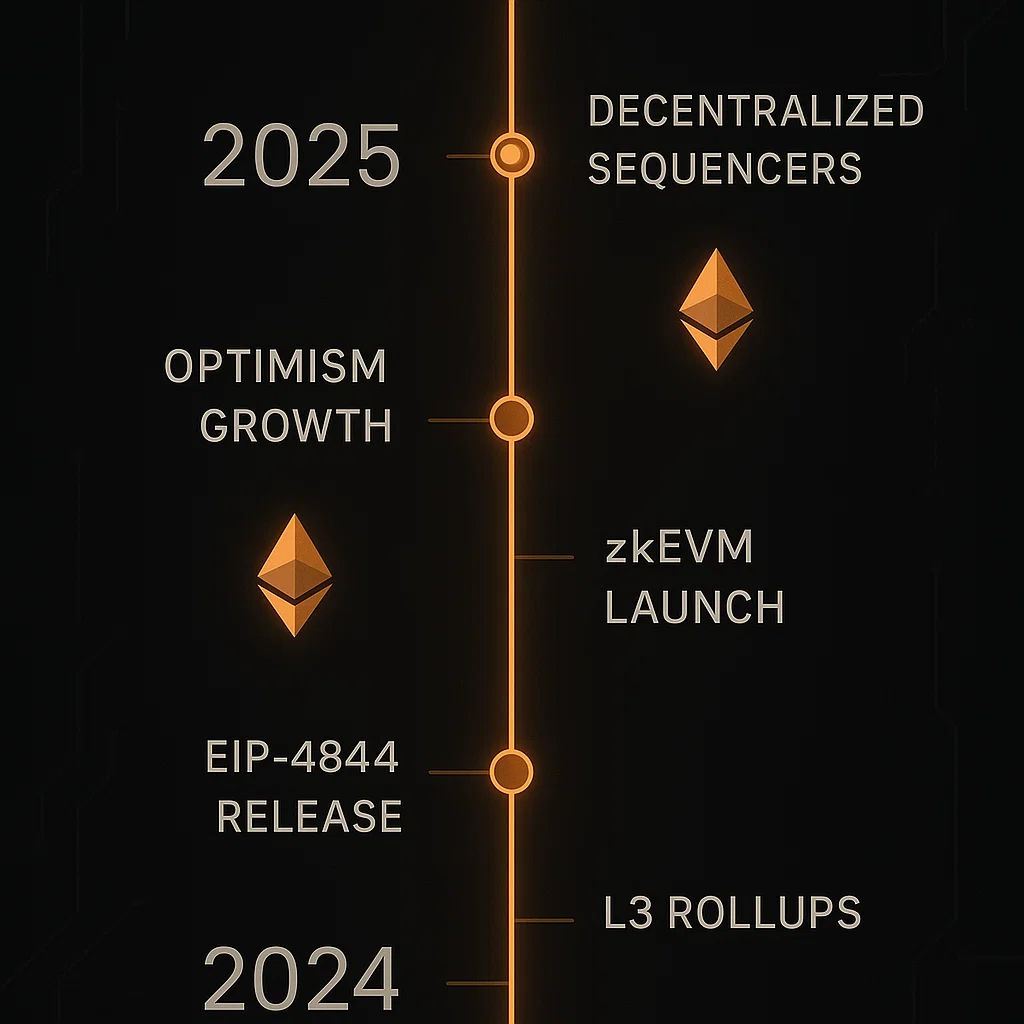
Until recently, most Layer 2 networks relied on centralized sequencers single entities responsible for ordering transactions. This was a centralization risk. Now, we’re seeing decentralized sequencer models emerge, improving censorship resistance and security.
In parallel, better cross-rollup messaging protocols are making inter-chain communication seamless, helping solve the problem of ecosystem fragmentation.
Support our mission to educate the Web3 community make a donation and help us keep building open, honest blockchain content.
EIP-4844 and the Modular Future
Ethereum’s upcoming EIP-4844, or Proto-Danksharding, introduces a new type of data called “blobs.” This greatly enhances data availability and reduces costs for Layer 2s. It also enables a new design pattern: Layer 3 rollups.
Layer 3s are specialized environments built on top of Layer 2s, offering even more tailored performance, privacy, or domain-specific logic. This trend marks the transition toward modular blockchain infrastructure where components like execution, data, and consensus are decoupled.
Community-Powered ZK Proofs
Another exciting innovation is CrowdProve, a decentralized approach to generating ZK-proofs using community resources. Instead of relying on a single prover node, this model shares the load across a distributed network. The result: faster proof generation, greater redundancy, and stronger decentralization.
This innovation helps lower the barrier to entry for smaller projects while improving trust across the board.
Choosing the Right Layer 2 for Your Use Case
Here’s a comparison chart to help choose the best Layer 2 for your needs:
| Use Case | Recommended Layer 2 | Why |
|---|---|---|
| DeFi & smart contracts | Arbitrum or Optimism | Broad adoption, low fees, deep tooling |
| High-speed dApps | Polygon zkEVM | EVM-compatible, ultra-fast, zk-powered |
| Complex computation | StarkNet | Ideal for logic-heavy workloads |
| Mass adoption projects | Base | Strong Coinbase backing, high TVL |
| Gaming or microtransactions | Mantle | Fast block times, low latency |
Looking to earn crypto while learning? Check out our Earn page for a list of tools, airdrops, and educational missions.
Security Considerations for Layer 2 Adoption
Despite the benefits, every Layer 2 Scaling Solution has trade-offs:
- Withdrawal Delays: Optimistic rollups require challenge periods before withdrawals are finalized.
- Bridge Risk: Cross-chain asset transfers can be vulnerable if bridges are poorly audited.
- Liquidity Fragmentation: Funds and dApps are sometimes siloed by ecosystem.
- Audits and Upgrades: Regular security audits and active governance are essential for maintaining trust.
Choosing the right Layer 2 also means aligning with the project’s roadmap, funding, and technical foundation.
Despite these risks, Layer 2 Scaling Solutions continue to improve in security, decentralization, and governance maturity.
The Future of Layer 2 Scaling Solutions
Looking forward, Layer 2 Scaling Solutions are moving toward deeper decentralization, modular execution, and user-centric design. With EIP-4844, L3 development, and innovations like CrowdProve, the next generation of blockchain infrastructure is set to be faster, safer, and more flexible than ever.
As more applications move from theory to real-world usage, the importance of Layer 2s will only increase. They’re not just a technical fix they’re the foundation of scalable, inclusive Web3.
Conclusion
By 2025, Layer 2 Scaling Solutions have matured into mission-critical infrastructure for the blockchain ecosystem. Whether you’re building in DeFi, NFTs, gaming, or enterprise tech, adopting the right Layer 2 is no longer a question of “if,” but “which one.”
From Optimistic Rollups explained through Arbitrum and Optimism, to advanced zero-knowledge systems like Polygon zkEVM and StarkNet, developers now have powerful tools to scale globally.
As adoption grows, Layer 2s will continue to redefine how we build on-chain. If you’re planning your next project, it’s time to think beyond Layer 1 and go where the real performance lives.
Looking ahead, Layer 2 Scaling Solutions will remain central to any strategy aimed at scaling Ethereum and similar networks.
Want to stay ahead of the Web3 curve? Join the BlockchainDudes newsletter for weekly insights, guides, and real-world use cases on scaling, DeFi, and crypto security.
Are Layer 2 networks secure?
Yes Layer 2 inherits security from the underlying Layer 1 blockchain (e.g., Ethereum). Optimistic rollups rely on fraud-proof mechanisms, while zk-rollups use cryptographic proofs. Recent upgrades also bring decentralized sequencer models and rigorous audits.
Why do we need Layer 2 if Ethereum continues to upgrade?
Ethereum upgrades like sharding are incremental. Layer 2 offers immediate scalability and cost-efficiency while Ethereum upgrades catch up.
What are Layer 3 rollups?
Layer 3 rollups are rollups built on top of Layer 2 networks, enabling highly customized, domain-specific chains with even greater throughput, privacy, or features.
Can I move assets freely across Layer 2 networks?
Bridges enable asset movement across L2s, but users must handle bridging delays and potential liquidity fragmentation.
Guess what? When you click and buy via our links, you’re not just enhancing your experience you‘re also supporting our content creation for free, so we can keep sharing useful blockchain insights. It‘s a pump for both of us!
— Black