

Introduction
As the blockchain space matures and scalability becomes a top priority, restaking is proving to be one of the most transformative innovations within the staking economy. It introduces a dynamic approach to capital efficiency, network security, and validator participation allowing users to earn additional rewards by reallocating staked assets without unbonding them.
This isn’t just a technical upgrade it’s a shift in how value and trust are leveraged in Web3. Instead of being locked into a single layer, staked assets now become modular, composable components of broader decentralized systems. This kind of flexibility is critical in the modern crypto landscape, where capital efficiency often determines a protocol’s survival.
Whether you’re an investor, validator, or DeFi enthusiast, understanding what is restaking and how it works is essential for navigating the modular blockchain ecosystems of 2025. The adoption of this model is growing rapidly across Layer 2 rollups, data availability layers, zk-based protocols, and oracle infrastructure.
What Is Restaking?
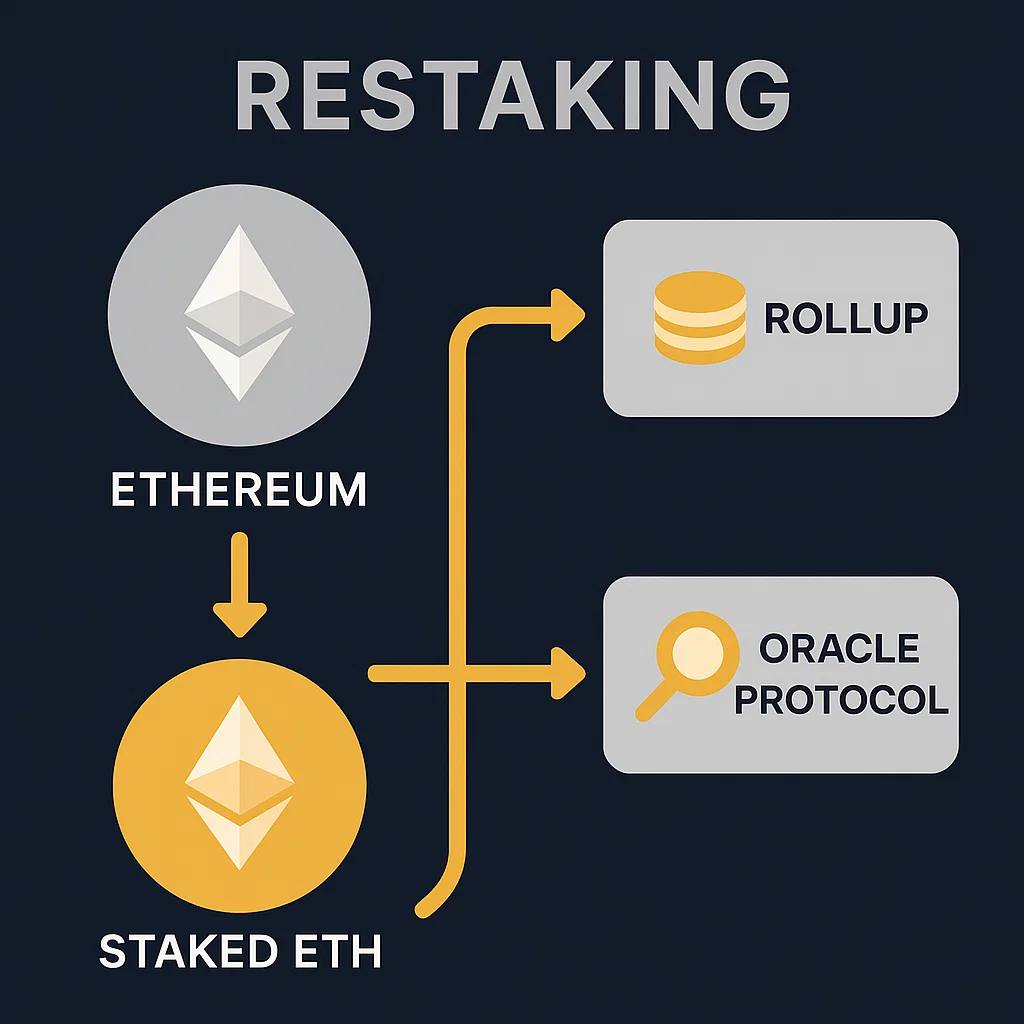
Restaking is the process of reusing already-staked assets such as ETH locked on Ethereum to secure additional networks, protocols, or services. Instead of unstaking or withdrawing from the original base layer, users opt into restaking protocols that assign new duties to their existing staked capital. These duties might include validating rollups, securing oracles, powering AI models, or anchoring fraud-proof chains.
This method is a breakthrough in blockchain design because it allows value to be extracted from locked assets while still preserving their security role in the original network. The idea aligns with Ethereum’s evolving ecosystem goals supporting decentralization while enabling performance at scale.
For example, if a user stakes 32 ETH on Ethereum and opts into a restaking protocol, that same ETH can simultaneously secure a Layer 2 rollup and an oracle layer earning yields from each. This creates a layered trust economy that didn’t exist in earlier staking paradigms.
By participating in restaking, you help support How Decentralized Finance (DeFi) is Evolving in 2025, especially as modular architectures and Layer 2 solutions become the new norm. It’s a system that empowers protocols to “borrow” trust instead of building it from scratch.
Why the Term “Coined”?
The term “restaking” gained traction thanks to protocols like EigenLayer, which pioneered the concept of assigning existing staked assets to secondary validation roles. These additional duties form a decentralized marketplace for security, allowing smaller or newer protocols to “rent” trust from battle-tested validator networks.
This approach democratizes network security. Instead of requiring millions in native tokens to bootstrap their own validator network, a new protocol can inherit Ethereum-grade security through a permissionless opt-in by stakers. The power dynamic between stakers, validators, and protocols is shifting toward a more composable and incentive-aligned structure.
The ability to reuse staked assets across multiple services reflects a fundamental principle in Tokenomics: The Science Behind Cryptocurrency Valuation that utility must be maximized per token without diluting its primary function.
How Restaking Works in 2025
Step-by-Step Process
The process in 2025 is highly streamlined, supported by smart contracts, validator interfaces, and restaking dashboards.
Primary Staking
You begin by staking your tokens (e.g., ETH) on a base layer like Ethereum. This can be done through solo validator nodes, staking pools, or liquid staking protocols like Lido or Rocket Pool.
Opt-In for Extended Use
Via a restaking protocol like EigenLayer or Restake Network, you opt in to assign your staked tokens to new roles. This usually requires connecting your wallet, signing a message, and selecting secondary services you wish to support.
Execution of Secondary Duties
Your restaked tokens are now delegated to support new tasks. These include securing rollups, processing zero-knowledge proofs, anchoring data feeds, or performing consensus services for modular appchains.
Reward Distribution
Users earn staking rewards from the base layer and additional yields from the protocols using their restaked capital. Rewards can vary based on task type, uptime, and performance metrics.
Monitoring, Penalties, and Slashing
Protocols enforce slashing and penalties if validators misbehave. Most also offer real-time dashboards to track validator performance, rewards, and risk status.
Real-World Example
Imagine Alice, a validator who stakes 64 ETH on Ethereum. Using EigenLayer, she opts in to restake 32 ETH to secure a decentralized oracle protocol and 32 ETH to validate a zk-rollup on Optimism.
Without moving funds or switching chains, Alice is now contributing to three ecosystems simultaneously: Ethereum (her base), the oracle network, and the rollup. She earns staking rewards from Ethereum and additional fees from both protocols optimizing her earnings with the same capital.
Ready to turn your insights into action?
Create a Bybit account and claim up to $30,050 in bonuses, including $50 free just for getting started.
Leading Restaking Protocols in 2025
A few major platforms dominate the restaking landscape in 2025:
EigenLayer 2.0
Supports security outsourcing for rollups, Layer 2s, zk-infrastructure, and off-chain compute modules. It also introduces dynamic slashing, audit trails, and custom reward structures.
Restake Network
A cross-chain aggregator offering multi-token restaking for ETH, SOL, AVAX, and NEAR. Its dashboard supports validator ranking and restaking ROI tracking.
SecuStake
Focused on secure, cross-consensus validation. Offers restaking insurance, risk profiling, and enterprise-grade validator APIs.
These platforms have become the backbone of modular blockchain infrastructure and represent a core part of A Beginner’s Guide To Decentralized Finance (DeFi).
Benefits of Restaking
Capital Efficiency
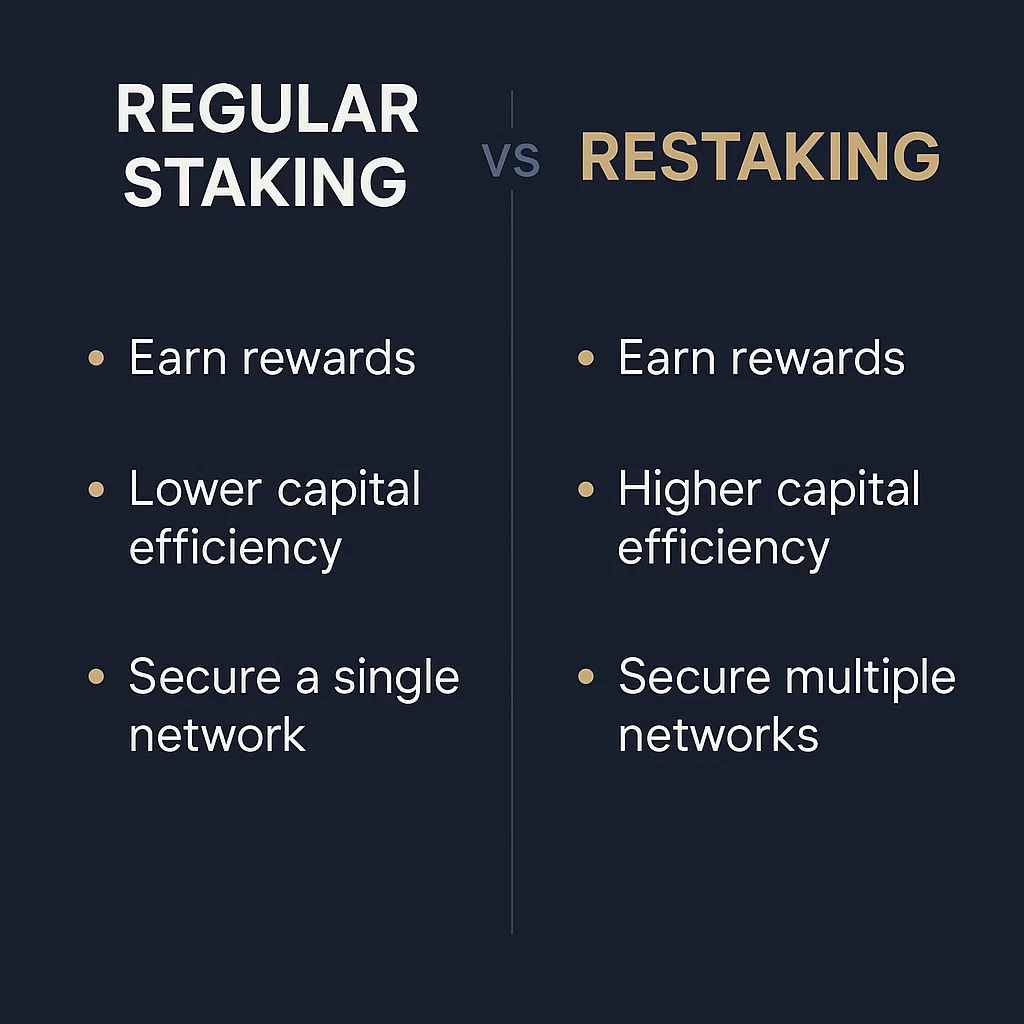
One of the main advantages of restaking is the ability to generate multiple income streams without additional capital. Users can stack yield layers by supporting several networks with the same stake.
Want to discover more ways to maximize your crypto income? Check out our Earn section for strategies, tools, and guides.
Increased Security Coverage
Protocols can access validator power from Ethereum without setting up their own networks. This borrowed trust improves decentralization and removes entry barriers for smaller players.
Yield Diversification
Instead of being locked into a single staking yield, restakers can earn rewards from multiple protocols diversifying income and spreading risk.
Empowering New Protocols
Restaked capital secures innovative services like zk-daemons, oracle layers, and verifiable compute networks. These modules wouldn’t be viable without external trust sources.
Risks and Considerations
Slashing Across Chains
If your validator is slashed on the base chain, that penalty may cascade across all associated restaked duties. Risk must be carefully managed, especially for non-custodial users.
Validator Centralization
Large validators may dominate restaked networks, creating potential points of failure or governance imbalance. Decentralized delegation and governance models are essential mitigations.
Protocol Risk and Exploits
As with any composable system, restaking introduces attack surfaces. Smart contract exploits or governance manipulation in restaking protocols could compromise your stake.
Key Use Cases in 2025
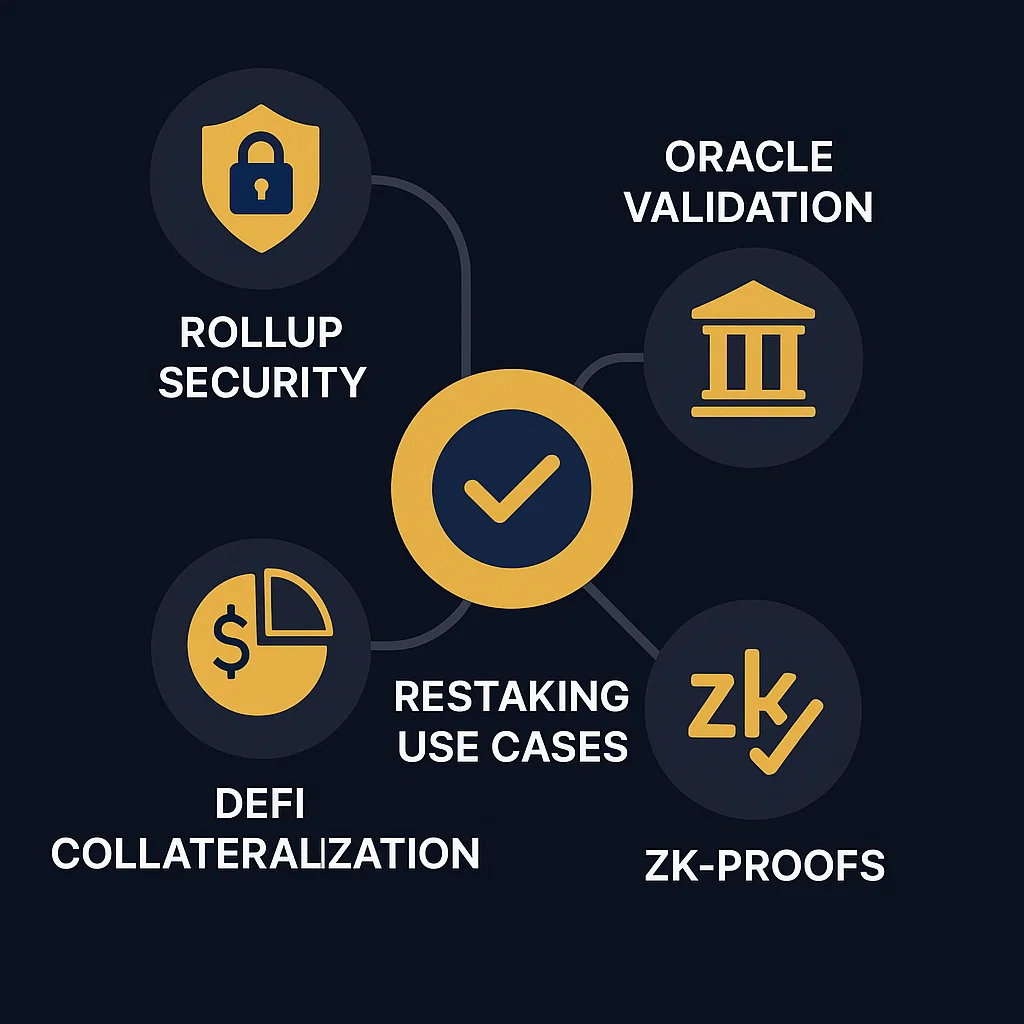
Rollup Security
Rollups like zkSync and Arbitrum Orbit rely on restaked ETH to validate fraud proofs, produce checkpoints, and anchor off-chain activity to Ethereum.
Oracle Infrastructure
Protocols such as Chainlink and SupraOracles use restaked tokens as collateral for delivering tamper-proof data. Validators are financially liable for the quality and accuracy of their submissions.
Financial Collateral in DeFi
Restaked assets can be used as collateral in lending protocols, vault strategies, or structured DeFi products. This unlocks liquidity from staked positions without reducing network security.
How to Get Started
- Stake Your Base Token
Stake ETH or SOL using a preferred provider (e.g., solo validator, Lido, or Coinbase Cloud). - Choose a Restaking Protocol
Research protocols for security, insurance coverage, and yield history. - Connect and Opt-In
Use the dashboard to assign your stake to eligible restaking tasks like rollup validation or data availability. - Monitor Performance
Keep track of your validator reputation, slashing metrics, and yield distributions using analytics dashboards. - Adjust Accordingly
Based on market conditions or new restaking opportunities, reassign or withdraw assets safely.
Why Restaking Matters for the Future
In 2025 and beyond, restaking will likely be the core of multichain coordination. It empowers:
- Scalable Security for smaller networks
- Cross-chain Interoperability between modular chains
- Sustainable Tokenomics without inflation-based incentives
- DeFi Liquidity Unlocks without compromising validator trust
It will also reshape how Web3 applications structure their trust layers making restaking not just a tool for validators but a foundation for next-gen applications.
If you value the research and content we publish, consider supporting BlockchainDudes so we can keep delivering high-quality insights on the future of Web3
Final Thoughts
Restaking is no longer a niche experiment it’s a structural upgrade to how blockchain security, rewards, and participation are managed. It allows you to make more with less, while supporting emerging protocols that rely on borrowed trust.
But like any powerful tool, it must be used responsibly. Choose audited protocols, stay informed about slashing conditions, and rebalance your strategy as new opportunities arise.
This is not just another DeFi yield hack restaking is the evolution of staking itself. And for those who understand its mechanics today, the future holds unmatched potential.
Want more alpha like this?
Join our free newsletter and get cutting-edge insights on blockchain, DeFi and Web3—straight to your inbox.
What is restaking?
Restaking means reusing already‑staked tokens on a base blockchain to perform validation or services on another network, in order to earn additional rewards.
Is restaking safe?
It can be but it involves added risk such as slashing on both the original and secondary chains, protocol vulnerability, and centralization risks. Choosing audited platforms with insurance features is crucial.
Can I restake ETH from Lido or Rocket Pool?
Yes, many restaking protocols support pooled staked ETH from Lido, Rocket Pool, and solo validators, as long as users opt in via the protocol dashboard.
What rewards can I expect from restaking?
You earn your base-layer staking rewards plus supplementary incentives from secondary tasks performance varies by protocol.
When did restaking gain prominence?
While the concept existed earlier, restaking saw widespread adoption in 2024 and became a foundational element in DeFi design by mid‑2025.
Guess what? When you click and buy via our links, you’re not just enhancing your experience you‘re also supporting our content creation for free, so we can keep sharing useful blockchain insights. It‘s a pump for both of us!
— Black