
Understanding On-Chain vs Off-Chain Transactions
In the fast-evolving world of blockchain, not all transactions follow the same path. Understanding on-chain vs off-chain transactions is essential to navigate the crypto space intelligently. As more individuals and businesses explore the potential of cryptocurrencies and decentralized finance (DeFi), understanding the difference between on-chain vs off-chain transactions becomes crucial. The two systems serve different purposes and come with unique benefits and limitations. This guide provides a comprehensive breakdown to help you make the right decision based on your needs whether you’re safeguarding high-value transfers or optimizing everyday micropayments.
What Is an On-Chain Transaction?
To fully grasp the debate around on-chain vs off-chain transactions, it’s essential to first answer the question: what is an on-chain transaction?
An on-chain transaction refers to any interaction that occurs directly on a blockchain network, such as Bitcoin, Ethereum, or Solana. It is broadcast to all nodes in the network, verified by a consensus algorithm like Proof of Work or Proof of Stake and permanently recorded on the public ledger. This makes it immutable, transparent, and traceable.
Once the transaction is included in a block and confirmed, it becomes a permanent part of the blockchain history. This system is the foundation of decentralized systems and aligns with the principle of trustless peer-to-peer interaction.
This foundational knowledge is crucial when comparing on-chain vs off-chain transactions, as each follows a completely different process and logic.
Benefits of On-Chain Transactions
Security and Immutability
On-chain transactions provide the highest level of security. Once validated and stored in a block, they cannot be altered or reversed. This ensures trustless execution, eliminating the need for centralized oversight.
Transparency
Every transaction is visible on the blockchain, allowing anyone to audit or verify past transfers. This feature is especially important for regulatory compliance, public accountability, and open-source finance.
Decentralization
Because all validations occur across a decentralized network, there’s no need for intermediaries such as banks or custodians. This makes the process censorship-resistant and globally accessible.
Trade-Offs of On-Chain Transactions
Despite their strengths, on-chain transactions come with significant limitations.
High Fees
Network congestion can drastically increase gas fees or miner fees, particularly on networks like Ethereum. During peak periods, simple token transfers can become costly.
Slow Confirmation Times
Transactions may take several minutes or even hours depending on the blockchain’s current load and block finality speed.
Limited Scalability
Most Layer 1 blockchains process a limited number of transactions per second. For example, Bitcoin handles around 7 TPS (transactions per second), while Ethereum averages 15–30 TPS.
These limitations are often the very reason why developers explore on-chain vs off-chain transactions as part of a hybrid scaling strategy.
When to Use On-Chain Transactions
On-chain transactions are ideal for:
- High-value transfers requiring maximum security
- Executing smart contracts
- Token minting (e.g., NFTs)
- Activities demanding public verifiability and audit trails
For more in-depth knowledge, read our guide: “How Smart Contracts Work On Blockchain“.
What Are Off-Chain Transactions?
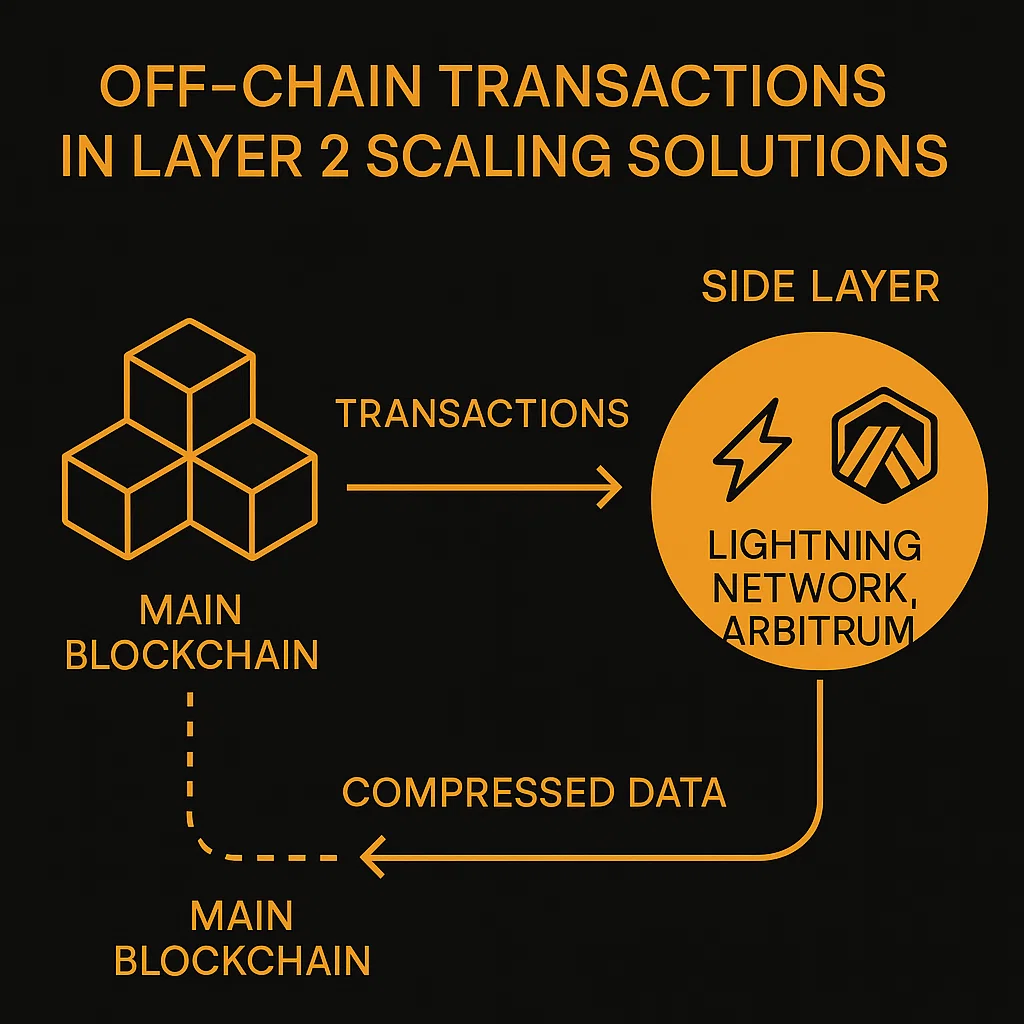
In contrast to the standard blockchain method, off-chain transactions occur outside the primary blockchain network. They are often facilitated by Layer 2 solutions, sidechains, or centralized custodians. These transactions are not immediately recorded on the blockchain, allowing for quicker and cheaper operations.
If you’re interested in topics like this one, explore more in our Blockchain section where we dive deep into the core technologies behind decentralization.
Common Off-Chain Technologies
- Bitcoin Lightning Network: A Layer 2 protocol allowing instant, low-cost BTC transfers.
- Ethereum Rollups (e.g., Optimism, Arbitrum): Aggregate thousands of transactions off-chain and periodically settle them on Ethereum.
- Custodial Services: Exchanges and payment providers enable transfers internally without broadcasting them to the blockchain.
Advantages of Off-Chain Transactions
Speed
Because off-chain transactions don’t require global consensus, they can be executed almost instantly. This is especially useful for point-of-sale interactions, gaming, and other real-time applications.
Lower Fees
By bypassing on-chain execution, users can avoid high gas fees. Batch processing and internal ledger updates dramatically reduce transaction costs.
Enhanced Privacy
Since these transactions are not immediately posted to public ledgers, they offer more discretion ideal for micropayments and daily use.
High Scalability
Off-chain systems can handle thousands of transactions per second, making them ideal for high-frequency environments like gaming, DeFi trading, and social apps. These benefits are what make on-chain vs off-chain transactions a recurring topic in the optimization of blockchain performance.
Drawbacks of Off-Chain Transactions
Despite their performance benefits, off-chain transactions carry certain risks.
Security Concerns
Because they often rely on third-party validators or smart contracts, off-chain systems are vulnerable to bugs, fraud, and mismanagement.
Reduced Decentralization
Some off-chain solutions involve semi-centralized operators, reducing the decentralization benefits of blockchain.
Regulatory Gray Areas
Legal ownership is not always clear until final settlement occurs on-chain. This can be problematic for legal and compliance purposes.
When to Use Off-Chain Transactions
Off-chain transactions are best suited for:
- Microtransactions and tipping
- Crypto gaming
- In-app purchases
- High-frequency, low-cost transfers
If you’re interested in blockchain foundations, don’t miss our article: “What Is A Layer 1 Blockchain?”
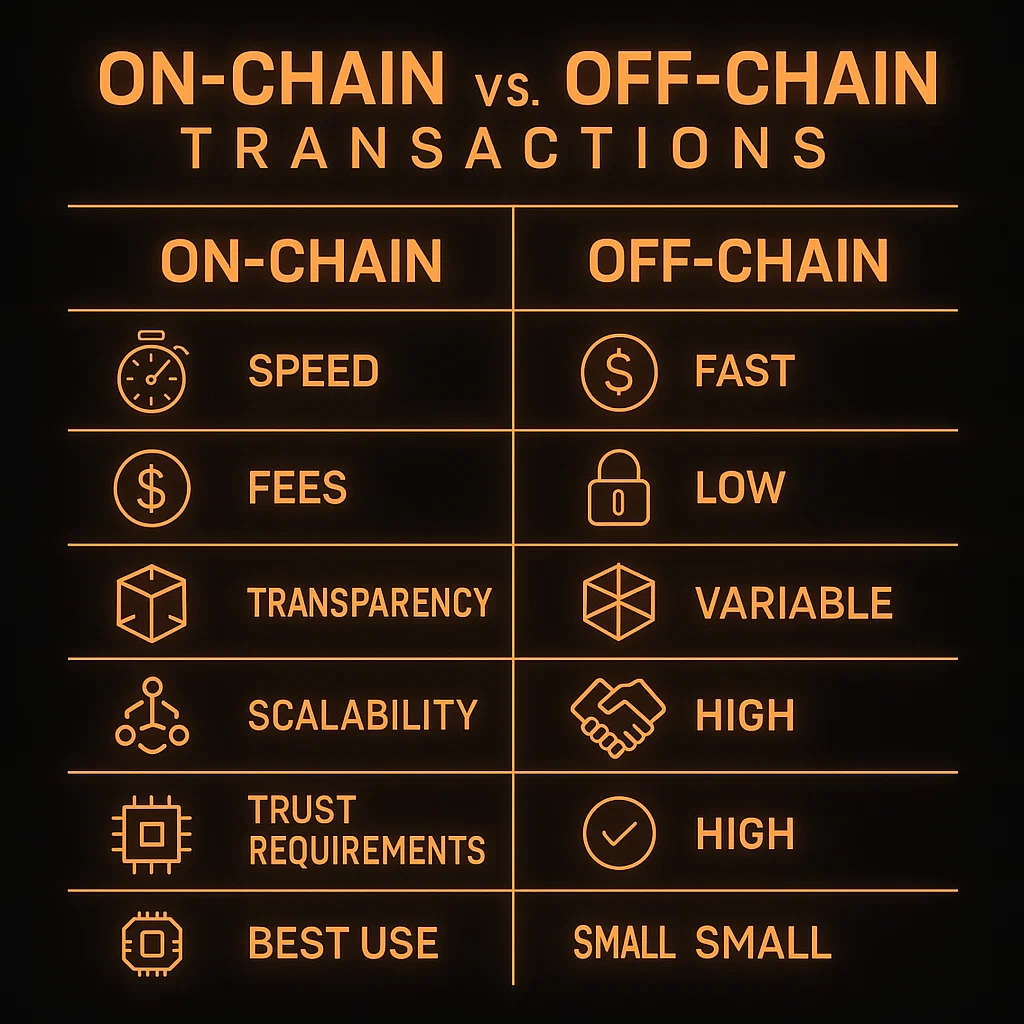
On-Chain vs Off-Chain Transactions: Side-by-Side Comparison
| Feature | On-Chain | Off-Chain |
|---|---|---|
| Speed | Minutes to hours | Instant or near-instant |
| Fees | High (gas, miners) | Low to negligible |
| Security | Very high | Variable, depends on implementation |
| Transparency | Fully public | Private until final settlement |
| Scalability | Low (limited TPS) | High throughput |
| Trust Requirements | Trustless | Requires trust in third-party/system |
| Best For | High-value, auditable uses | Routine, small, fast, and frequent usage |
Real-World Use Cases
In real-world applications, knowing when to use on-chain vs off-chain transactions can significantly impact both cost and security.
Choose On-Chain When:
- Sending large sums or critical data
- Interacting with smart contracts and DeFi platforms
- Regulatory compliance and auditability are required
Choose Off-Chain When:
- Making microtransactions
- Needing real-time transfers
- Prioritizing privacy over auditability
Security and Fraud Considerations
On-chain transactions are inherently secure due to blockchain immutability. Once validated, the data cannot be reversed. This minimizes the risk of fraud or tampering.
In contrast, off-chain transactions introduce new risks. Users must trust intermediaries or smart contract logic, which have occasionally been exploited in rollup or custody platform hacks. Monitoring settlement windows and performing regular audits is essential when engaging in off-chain activity.
For best practices, always use well-audited Layer 2 protocols and understand the system’s fail-safes.
The Blockchain Trilemma
The ongoing debate of on-chain vs off-chain transactions also ties into the blockchain trilemma balancing security, scalability, and decentralization.
Developers often weigh on-chain vs off-chain transactions when prioritizing decentralization, speed, or security.
- On-chain solutions prioritize security and decentralization but sacrifice scalability and speed.
- Off-chain approaches offer scalability and performance but often compromise on decentralization or trust.
Innovations such as zk-rollups, validiums, and modular blockchains are emerging to address these limitations. The industry is moving toward hybrid models that aim to integrate the best of both worlds.
Choosing the Right Strategy
There is no one-size-fits-all solution. Your choice between on-chain vs off-chain transactions should align with your specific priorities:
- Need transparency and permanent records? Go on-chain.
- Need performance and cost-efficiency? Choose off-chain.
- Want both? Use a hybrid strategy conduct daily activity off-chain and settle critical data or payments on-chain.
Want weekly insights like this in your inbox? Subscribe to the BlockchainDudes Newsletter for expert guides, alpha on Web3 trends, and real-use breakdowns built for builders.

Future Outlook
The blockchain ecosystem continues to evolve toward interoperable hybrid models. Tools are emerging that allow developers to integrate on-chain and off-chain functionalities into seamless user experiences. This includes advancements in Layer 2 systems, wallet support, and smart contract frameworks.
In the coming years, we can expect:
- Better developer tools for building cross-layer dApps
- Enhanced wallet compatibility with Layer 2
- Scalable solutions for both enterprise and consumer-level use
Conclusion
Choosing between on-chain vs off-chain transactions is not just a technical decision it’s a strategic one. On-chain offers unmatched transparency, security, and decentralization. Off-chain delivers lightning-fast performance and low costs.
As blockchain adoption grows, understanding on-chain vs off-chain transactions will be key to building efficient, secure, and scalable systems.
Understanding the trade-offs allows you to leverage blockchain’s full potential. Whether you’re building a dApp, transferring assets, or optimizing user experience, the right transaction model will align with your project’s goals and your audience’s expectations.
What’s the main difference between on-chain and off-chain transactions?
On-chain transactions are recorded directly on the blockchain and validated by the network, while off-chain transactions occur outside the main chain, offering faster speeds and lower costs.
Are off-chain transactions secure?
It depends on the technology used. Many off-chain solutions, like Layer-2 networks, are highly secure if well-designed, but they involve some level of trust in the intermediary or smart contract.
When should I use an on-chain transaction?
On-chain transactions are ideal for high-value transfers, smart contract interactions, or whenever a permanent, transparent record is required.
Are Layer-2 networks considered off-chain?
Yes. Layer-2 solutions like the Lightning Network or Arbitrum operate off-chain and later settle batches of transactions on the main blockchain.
Can I combine on-chain and off-chain methods in my operations?
Absolutely. Many users rely on off-chain transactions for speed and low fees, while using on-chain methods for critical actions that demand maximum security and transparency.
Guess what? When you click and buy via our links, you’re not just enhancing your experience you‘re also supporting our content creation for free, so we can keep sharing useful blockchain insights. It‘s a pump for both of us!
— Black