
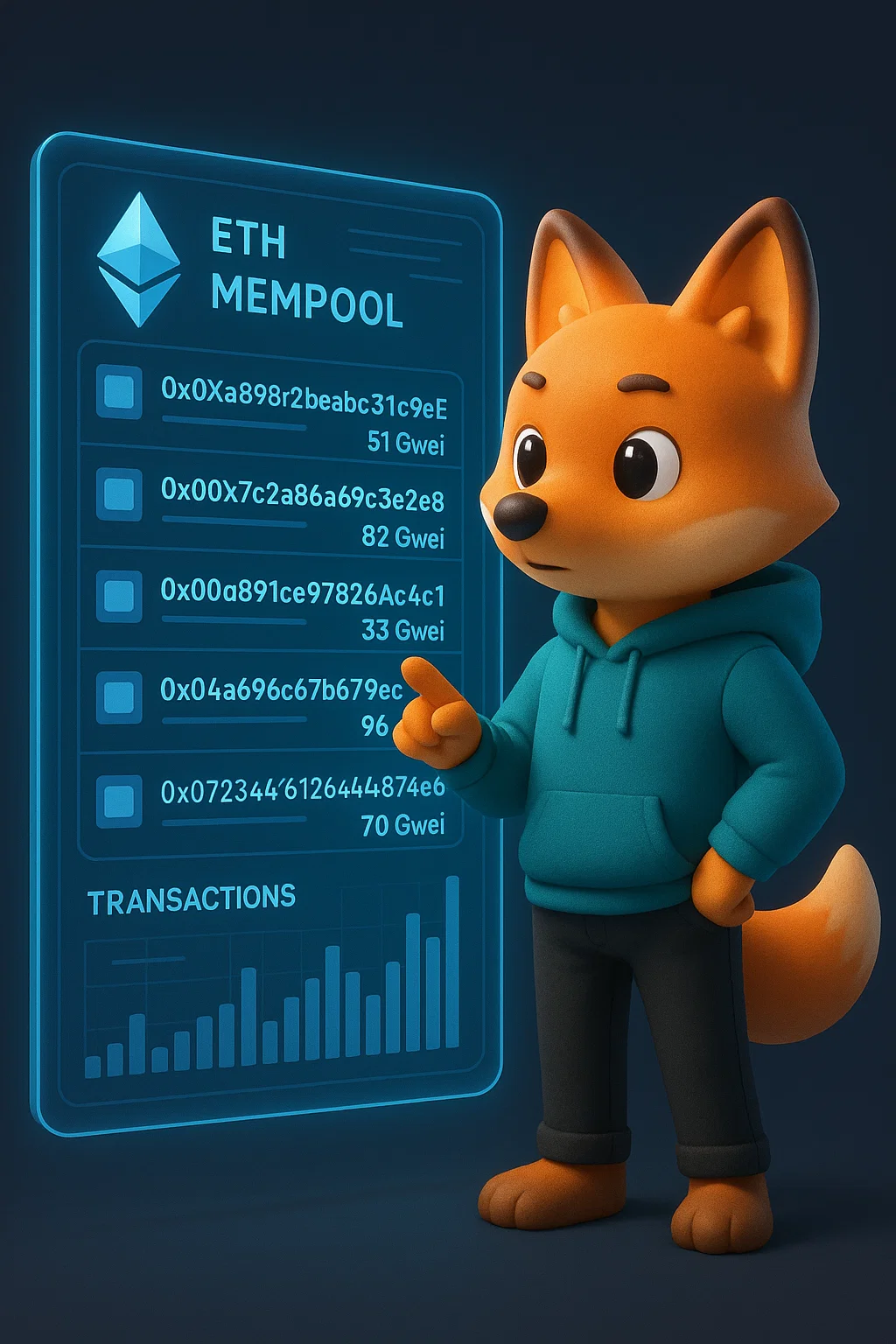
What Are MEV Bots?
MEV Bots, or Maximum Extractable Value bots, are automated agents operating in decentralized finance (DeFi) ecosystems. These bots scan blockchain networks like Ethereum for profitable opportunities by reordering, inserting, or censoring transactions in a block. Initially known as Miner Extractable Value, the term has evolved with Ethereum’s shift to Proof of Stake (PoS), reflecting that validators (not miners) now control transaction inclusion and ordering.
These bots aren’t random scripts—they’re powerful algorithms designed to capitalize on inefficiencies or temporary imbalances within decentralized markets. Their operations are precise, often measured in milliseconds, and they have become a fundamental layer of the DeFi value chain.
How MEV Bots Work
Scanning the Mempool
MEV bots observe the mempool, the public waiting area where transactions sit before being confirmed. Here, they identify transactions with profit potential—whether due to arbitrage, liquidations, or slippage from large swaps. Once a profitable situation is found, bots build a bundle of custom transactions that they submit to block producers or private relays to gain priority inclusion.
Bundles and Private Relays
Rather than broadcasting to the public mempool, MEV bots often send bundles to Flashbots or similar private channels. This minimizes front-running, gas wars, and failed transactions, increasing both the efficiency and the profitability of the operation.
Common MEV Bot Strategies
Arbitrage Bots
These MEV bots monitor price differences across decentralized exchanges (DEXs) such as Uniswap, Curve, or SushiSwap. If a token trades at $1.02 on one DEX and $1.00 on another, a bot can execute a buy low, sell high sequence nearly instantly, capturing the spread.
Sandwich Bots
Among the most controversial types, sandwich bots insert trades before and after a large pending transaction. For example, if a user submits a large buy order, the bot preemptively buys the same asset, waits for the price to rise, then sells it right after“sandwiching” the original transaction.
Liquidation Bots
On lending protocols like Aave and Compound, MEV bots monitor for undercollateralized positions. When a loan breaches the required collateral ratio, bots can trigger a liquidation and claim part of the borrower’s assets as a reward.
Back-Running Bots
These bots analyze impactful trades and act right after them, capitalizing on the resulting market movement. Back-running isn’t inherently harmful, but it often rewards those with faster execution and more capital.
Flashbots and Ethical MEV
Flashbots plays a central role in the MEV ecosystem. It was created to democratize MEV access and reduce negative externalities like front-running and gas bidding wars. Flashbots introduced the concept of private bundles—transactions sent directly to validators—improving both execution and fairness.
MEV-Boost and Proposer-Builder Separation (PBS)
Flashbots also developed MEV-Boost, which separates the role of block builders from block proposers. Builders compete to assemble the most profitable bundles, while proposers simply select the most rewarding block. This separation increases decentralization and allows more fair access to MEV opportunities.
Pros and Cons of MEV Bots
The Upside: Efficiency and Liquidity
By exploiting inefficiencies, MEV bots help align token prices across DEXs, improving overall market efficiency. Arbitrage reduces volatility between platforms, and liquidation bots help maintain the solvency of lending protocols.
The Downside: User Exploitation and Inequality
Despite the benefits, MEV bots can significantly degrade user experience. They often extract value from regular users, who might receive less favorable prices, face increased slippage, or see their transactions front-run or delayed. This “invisible tax” especially affects users executing large trades or those with lower gas budgets.
“Want more crypto knowledge? Join our newsletter for weekly insights, free guides, and tools.”
MEV Bots as a Cost to Users
Let’s say a trader attempts to swap ETH for DAI on Uniswap. A sandwich bot might detect the transaction, front-run it, and sell ETH after pushing the price up—leaving the original trader with fewer DAI than expected. The loss isn’t visible, but it’s very real.
This illustrates how MEV bots, while not malicious, can extract value from unsuspecting users simply by taking advantage of public mempool transparency and market mechanics.

Mitigating the Impact of MEV Bots
Tools for Protection
To reduce the influence of MEV bots, protocols and users have started adopting several strategies:
- Flashbots Protect: Allows users to route transactions privately to validators, avoiding mempool exposure.
- CowSwap and Gnosis Protocol: Use batch auctions to execute trades at a uniform clearing price, eliminating sandwiching.
- Private Mempools: Offer privacy for high-value or time-sensitive transactions.
Layer 2 and Rollups
Layer 2 solutions such as zkSync and Arbitrum are exploring ways to redesign transaction ordering. By altering how blocks are finalized, these solutions aim to reduce or even neutralize MEV opportunities, protecting user value at the protocol level.
Validator Incentives and Centralization Risks
MEV as a Revenue Stream
For validators, MEV represents a lucrative income stream, often exceeding standard block rewards. This creates an incentive to favor MEV-rich bundles, especially if sourced through platforms like Flashbots.
Risk of Centralization
However, this profit potential introduces risks. If a small number of builders or relays control the majority of profitable bundles, the ecosystem risks centralizing MEV extraction, undermining the decentralized ethos of blockchains. Fair access and diversified participation remain critical.
“Ledger is the gold standard for hardware crypto wallets. Store your coins offline,
The Future of MEV Bot Regulation
Protocol-Level Fixes
Long-term solutions may come at the protocol layer. The Ethereum Foundation and other developers are researching ways to integrate MEV resistance directly into the blockchain. Potential approaches include encrypted mempools, delay functions, or even MEV-aware consensus mechanisms.
Community and Governance
As awareness of MEV bots grows, so does the call for governance involvement. Protocols and DAOs are starting to discuss how to balance MEV’s efficiency benefits with its downsides. Involving communities in these decisions helps maintain fairness and transparency.
Best Practices for Users
If you want to minimize your exposure to MEV bots, consider the following tips:
- Use MEV-protected wallets that route transactions through private channels.
- Trade via platforms like CowSwap that aggregate orders and protect users from front-running.
- Monitor gas fees and avoid submitting large trades during peak congestion periods.
- Stay informed about evolving MEV tools, especially if you’re a high-volume trader.
Are MEV Bots Good or Bad?
That depends on your perspective. MEV bots bring efficiency, liquidity, and incentives for validators. But they can also undermine fairness, especially for regular users. Ultimately, MEV bots operate within the rules defined by smart contracts and blockchain protocols. If their behavior feels unfair, it’s a signal that those rules need to evolve.
The challenge isn’t eliminating MEV bots—it’s designing ecosystems where value extraction aligns with community goals and decentralization ideals. With innovations like MEV-Boost and PBS, the crypto community is already moving in this direction.
Final Thoughts
MEV Bots are no longer an obscure niche—they are an integral part of how value moves in decentralized finance. From arbitrage to liquidation triggers, they play a vital role in the modern DeFi infrastructure. But their growing influence also raises important questions about equity, access, and decentralization.
Understanding how MEV bots work—and how to protect yourself from their downsides—is no longer optional for DeFi participants. Whether you’re a developer, validator, trader, or curious newcomer, the more you know about MEV bots, the better equipped you’ll be in this fast-moving financial frontier.
The crypto space thrives on innovation. MEV bots are proof that even in a trustless system, incentives shape behavior. It’s time we start shaping those incentives with intention.
Flashbots reduce bad MEV effects?
Flashbots runs private relays that bypass public mempools, enabling fair bidding for transaction bundles. This reduces front-running, gas bidding wars, and failed transactions.
Is there anything ordinary users can do to avoid being exploited by MEV bots?
Yes. Users can utilize batch auction platforms like CowSwap, route transactions through private relay providers such as Flashbots Protect, or set higher gas buffers to minimize failed or front-run transactions.
Can MEV bots operate on all chains?
MEV is present on any blockchain with a public mempool and decentralized exchange activity. Ethereum, Binance Smart Chain, and Arbitrum are commonly affected, though the intensity and types of MEV may vary from chain to chain.
Will MEV eventually harm DeFi decentralization?
There is a risk if MEV extraction becomes concentrated among a small group of builders or validators. However, open relay networks, fair sequencing mechanisms, and privacy-focused Layer 2 scaling solutions are being developed to protect decentralization.
“Guess what? When you click and buy via our links, you’re not just enhancing your experience—you‘re also supporting our content creation for free, so we can keep sharing useful blockchain insights. It‘s a pump for both of us!”
— Edo