What Is a Personal Brand in Web3?
A personal brand in Web3 is not just a digital identity—it is your entire presence across decentralized platforms, wallets, social protocols, and projects. Unlike traditional branding, where central authorities and algorithms control visibility, Web3 branding relies on authenticity, proof-of-work, and community engagement.
Building a recognizable personal brand in Web3 means positioning yourself as a trusted figure in a decentralized ecosystem. Whether you’re an artist, developer, educator, investor, or content creator, your on-chain footprint becomes your resume—and your voice, your greatest asset.
Why Personal Branding Matters More Than Ever
In the age of Web3, individuals have more power than ever to shape their reputation without needing approval from centralized institutions. Traditional resumes are being replaced by NFT credentials, on-chain contributions, and transparent community interaction.
A solid personal brand in Web3 allows you to:
- Attract collaboration with top-tier projects
- Monetize your knowledge via tokens, courses, or creator DAOs
- Build credibility through transparency and proof of participation
- Access opportunities like grants, jobs, partnerships, and speaking gigs
In a space that values decentralization, your personal brand is your strongest currency.
Laying the Foundation for Your Personal Brand in Web3
Before launching your brand into the Web3 universe, it’s essential to get the fundamentals right. You need a core message, visual identity, and a clear mission.
Step 1: Define Your Web3 Identity
Ask yourself:
- What is your mission in Web3?
- What value do you bring to the ecosystem?
- What roles do you want to be known for? (Builder, thought leader, educator, artist…)
This clarity helps align your messaging across all platforms, including Twitter, Farcaster, Lens, Discord, and your wallet-linked profiles.
Step 2: Build a Consistent Visual Brand
Even in decentralized environments, visual consistency boosts recognition. Use the same:
- PFP or avatar (ideally a verified NFT or custom identity)
- Color palette and design across mirror.xyz, link-in-bio pages, and posts
- Username/ENS that matches your handle (e.g., @dude.eth)
Your visual identity anchors your brand and makes you instantly recognizable across platforms.
Key Platforms to Build Your Personal Brand in Web3
In Web3, you’re not confined to LinkedIn or Instagram. Here are the most effective platforms to amplify your personal brand in Web3:
Twitter/X
This is still the heartbeat of crypto and Web3 discourse. Threads, memes, alpha leaks, and debates happen here. Stay active with educational content, updates on your journey, and strong opinions backed by research.
Farcaster and Lens Protocol
These decentralized social networks let you own your audience. Your followers move with you, censorship is minimized, and you can plug into new discovery algorithms like Warpcast or Lenster.
Discord and Telegram
These are community-building tools. Hosting AMAs, moderating DAOs, or just being active in protocol chats boosts your visibility and builds trust.
On-Chain Contributions
Use platforms like Gitcoin, PropHouse, or Snapshot to show your contributions. Participate in DAO governance, submit proposals, or fund projects. Your ENS or wallet becomes your CV.
Authenticity and Proof-of-Work: The New Trust Currency
In Web3, you can’t fake it. Your contributions are often on-chain, timestamped, and verifiable.
That means your personal brand in Web3 must be:
- Authentic: Don’t fake credentials or copy others’ content
- Consistent: Keep showing up even during bear markets
- Proven: Link your statements to what you’ve built or supported
The days of fluff are over. Web3 rewards builders, not talkers.
Creating Content That Grows Your Web3 Personal Brand
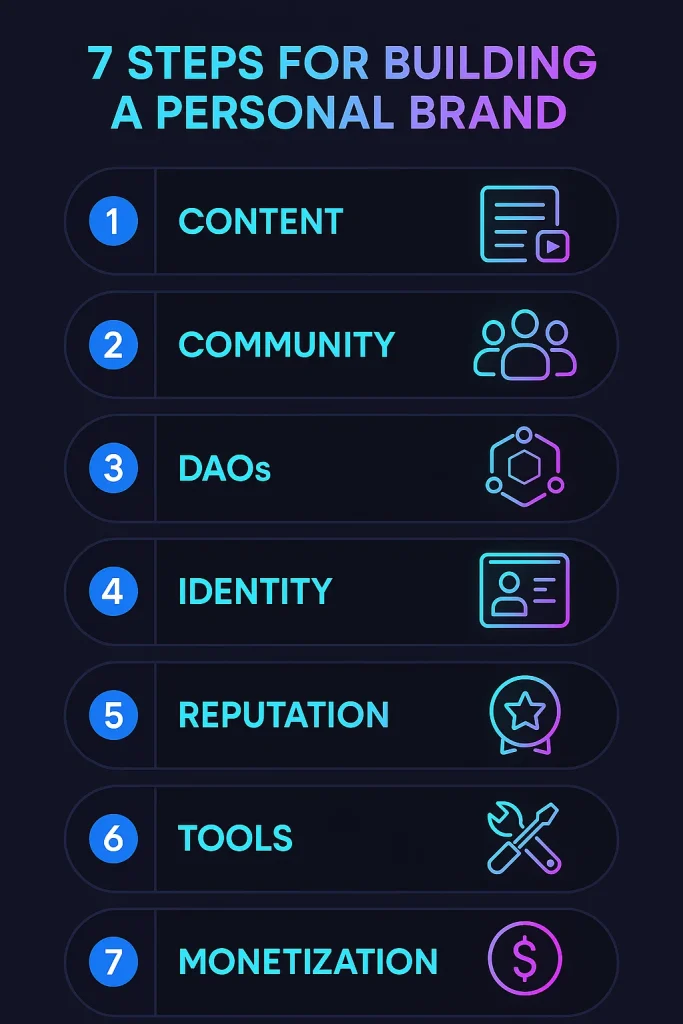
Content is the oxygen of your brand. But it’s not just about volume—strategic content aligned with your niche drives growth.
Educational Threads
Break down complex topics like staking, DeFi, or zk-rollups in simple terms. Use storytelling, analogies, and visuals to keep people hooked.
“Building in Public” Updates
If you’re building a tool, launching a project, or experimenting—document it. Share wins, lessons, and setbacks. Transparency breeds loyalty.
Video and Audio Content
Use short-form content (TikTok, Reels) or long-form (podcasts, YouTube) to reach new audiences. Speak directly to your camera or host spaces.
Blog on Mirror or Paragraph
Write deep dives, thought leadership pieces, and explainers. Sign your posts with your ENS or wallet address.
NFTs and Tokens as Personal Branding Tools
In Web3, NFTs aren’t just profile pictures. They’re powerful branding tools.
Launch a Genesis NFT
Use this as your membership badge, access token, or even a way to raise funds from early supporters.
POAPs (Proof of Attendance Protocol)
Create and distribute POAPs for events, Twitter Spaces, or collaborations. These badges signal community participation and loyalty.
Social Tokens
Consider launching a personal token for your community. It can gate content, allow governance, or even distribute rewards to your most active fans.
All these mechanisms reinforce your personal brand in Web3 by giving your community a piece of your journey.
Building and Nurturing Your Web3 Community
Your audience isn’t just spectators—they are participants in your mission. Here’s how to grow and engage them:
- Be active in comments and replies
- Run community polls and gather feedback
- Reward early adopters with whitelist spots or airdrops
- Host live events or Twitter Spaces regularly
- Tag and uplift other builders
A strong community becomes your amplifier, your support system, and your proof of legitimacy.
Mistakes to Avoid When Building a Web3 Personal Brand
Even in decentralized systems, your reputation is fragile. Here are common pitfalls to dodge:
- Overhyping with no delivery: Don’t promise what you can’t ship
- Ghosting after failure: Share your losses—Web3 respects transparency
- Not owning your mistakes: Deleting tweets or blaming others ruins trust
- Chasing every trend: Stay focused on your mission and don’t pivot every week
Remember: your personal brand in Web3 is a long game. It’s built block by block, not overnight.
The Role of DAOs in Strengthening Your Personal Brand
DAOs (Decentralized Autonomous Organizations) are one of the best ways to gain exposure, build experience, and connect with aligned communities.
Benefits for your personal brand:
- You get credit for votes, proposals, and initiatives on-chain
- You can reference your DAO contributions in job or grant applications
- You build your network around shared values
Choose DAOs that align with your mission and values. Don’t just join for the hype—contribute meaningfully.
How to Monetize Your Personal Brand in Web3
Once your personal brand in Web3 is established, you can turn reputation into revenue—without selling your soul.
Common Monetization Paths
- NFT collections (art, access passes, music, content)
- Token-gated courses or communities
- Affiliate links for wallets, platforms, or DeFi tools
- Sponsorships from DAOs or projects aligned with your values
- Creator grants from platforms like Gitcoin, Lens, or Paragraph
Web3 empowers creators and thinkers to earn directly from value provided, not from playing by Web2’s algorithmic games.
Staying Relevant in a Rapidly Changing Ecosystem
Web3 evolves fast. To keep your personal brand in Web3 strong:
- Keep learning: Stay updated on new L2s, protocols, and narratives
- Build in bear markets: That’s when attention is cheap and loyalty is earned
- Diversify your presence: Don’t rely on one platform or token
- Collaborate intentionally: Join forces with other builders who share your values
The brands that last in Web3 aren’t the loudest—they’re the most resilient, real, and consistent.
Final Thoughts: Be the Brand You Needed
Your personal brand in Web3 is your digital legacy. It’s what people remember when they see your ENS, your NFT, or your latest post. Build it with purpose, show up with consistency, and lead with value.
In a trustless world, your story is your edge. Make it count.
Do I need to reveal my real identity to build a Web3 personal brand?
Which platforms should I prioritize first?
Start lean: X (for reach), one decentralized social (Farcaster or Lens) to own your audience, and one long-form base (Mirror or Paragraph) for depth. Tie them together with an ENS and a link-in-bio. Show up daily on X, cast/post 3–5x/week, publish one high-quality long-form piece biweekly.
How can I show “proof-of-work” if I’m not a developer?
What content format grows a Web3 personal brand fastest?
Educational threads + “building in public” updates. Use a simple loop: teach (break down a concept), show (your experiment/result), proof (link on-chain or to a repo/POAP), ask (CTA for feedback). Add short video clips to expand reach; repurpose the same idea across X, Farcaster/Lens, and your blog.
How do I monetize ethically without shilling?
Offer value first, then: token-gated courses/communities, a Genesis NFT/pass, grants (Gitcoin/Lens/Paragraph), aligned sponsorships/affiliates with full disclosure, or consulting. Set expectations (no price promises), document deliverables, and keep receipts on-chain when possible to maintain trust.
“Guess what? When you click and buy via our links, you’re not just enhancing your experience—you‘re also supporting our content creation for free, so we can keep sharing useful blockchain insights. It‘s a pump for both of us!”
— Psycho