


Understanding the Role of a Cryptocurrency Exchange
The rise of cryptocurrencies has completely transformed how people think about money, ownership, and digital finance. But none of this innovation would be accessible without the existence of the cryptocurrency exchange. These platforms serve as the essential bridge between traditional fiat currencies and blockchain-based assets. Whether you’re new to crypto or an experienced investor, understanding how cryptocurrency exchanges work is a fundamental step toward navigating the digital asset space safely and effectively.
What Is a Cryptocurrency Exchange?
A cryptocurrency exchange is an online platform that allows users to buy, sell, and trade digital assets like Bitcoin, Ethereum, and thousands of other tokens. These platforms function similarly to traditional stock exchanges but are specifically designed for digital currencies. Users can convert fiat currencies (such as USD, EUR, or GBP) into crypto and vice versa, or swap one cryptocurrency for another.
Most exchanges operate 24/7, allowing real-time trading, price discovery, and liquidity across global markets. They play a crucial role in crypto adoption by making digital assets more accessible to everyday users, investors, and institutions.
How a Cryptocurrency Exchange Works
1. Account Registration and Verification
To begin using a cryptocurrency exchange, users typically need to register and verify their identity. This is often required for compliance with KYC (Know Your Customer) and AML (Anti-Money Laundering) regulations. Verification may include submitting identification documents and enabling two-factor authentication (2FA) for security.
2. Depositing Fiat or Crypto
Once the account is verified, users can deposit funds into the platform. This can be done via credit card, bank transfer, or by transferring existing cryptocurrencies into their exchange wallet. Some platforms also support alternative payment methods such as PayPal or Apple Pay.
3. Placing a Trade
Exchanges use trading interfaces with order books. Users can place market orders, which execute immediately at the best available price, or limit orders, which only execute at a specified price point. More advanced exchanges offer features like stop-loss, margin trading, and derivatives.
4. Settling and Withdrawing
After a successful trade, users can choose to keep their assets on the exchange or withdraw them to an external wallet. Withdrawals may incur fees and are often processed within a few minutes to a few hours depending on the platform and network conditions.
Types of Cryptocurrency Exchanges
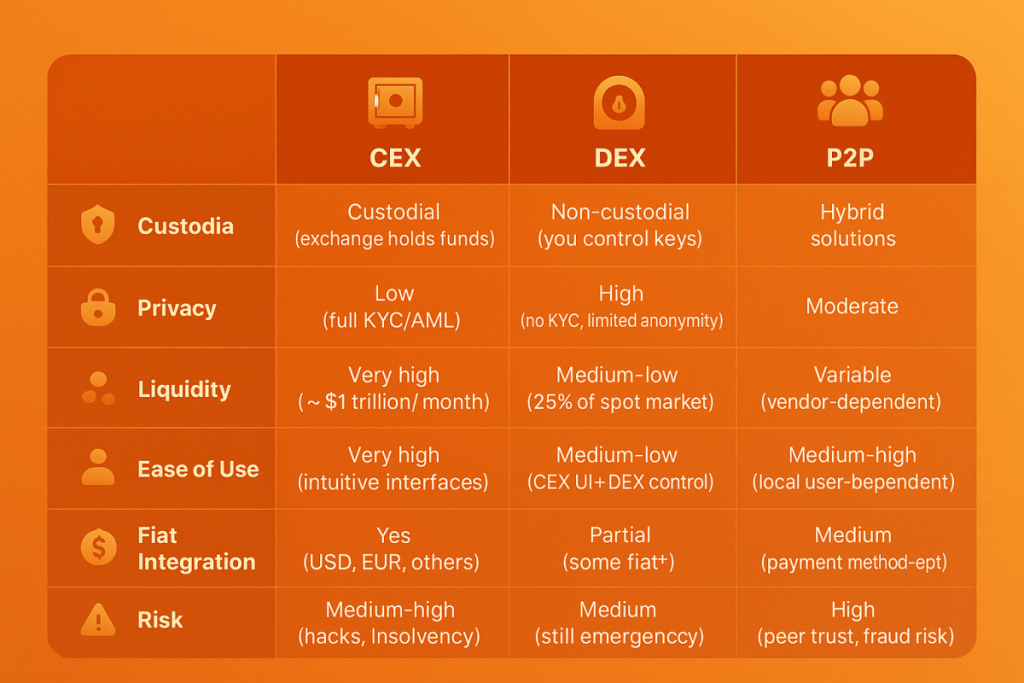
Centralized Exchanges (CEX)
Centralized exchanges (CEX) are the most common type. They are operated by companies that manage users’ funds and control the platform’s operations. Examples include Binance, Coinbase, and Kraken.
- Pros: High liquidity, fiat onramps, user-friendly interfaces, customer support
- Cons: Custodial risk, KYC required, subject to regulations and hacks
Decentralized Exchanges (DEX)
A decentralized cryptocurrency exchange (DEX) uses smart contracts and blockchain infrastructure to enable peer-to-peer trading without intermediaries. Platforms like Uniswap and PancakeSwap are popular examples.
- Pros: Full control over funds, anonymity, no central authority
- Cons: Complex interfaces, gas fees, limited fiat support
Hybrid Exchanges
Hybrid platforms aim to combine the benefits of both centralized and decentralized models. They may offer non-custodial wallets with centralized matching engines.
- Still emerging and not widely adopted yet
- Designed for advanced users who want privacy without losing speed and liquidity
Peer-to-Peer Exchanges (P2P)
Peer-to-Peer Exchanges (P2P) exchanges like LocalBitcoins or Paxful allow users to trade directly with one another, often with escrow services to reduce fraud. These are especially useful in countries with banking restrictions.
Key Features to Look For in a Cryptocurrency Exchange
Security
Security should be a top priority. The best exchanges use cold storage for most funds, multi-factor authentication, withdrawal whitelists, and routine audits.
- Look for platforms with a proven history of handling security threats
- Exchanges offering insurance or proof-of-reserves provide added transparency
Regulatory Compliance
A reliable cryptocurrency exchange will operate under licenses and follow regulatory frameworks. This includes:
- KYC and AML compliance
- GDPR for user data protection
- Licenses from authorities like FinCEN, FCA, or MAS
Supported Coins and Pairs
A good exchange supports a wide variety of trading pairs, including major tokens (BTC, ETH) and promising altcoins. It should also offer:
- Stablecoins like USDT, USDC
- Token staking or DeFi access
- NFT marketplaces or launchpads, if applicable
Fee Structure
Fees vary and include:
- Trading fees (usually 0.1% to 0.5%)
- Deposit/withdrawal fees
- Hidden fees for conversions or premium features
Always compare fee structures when evaluating platforms.
Liquidity and Volume
Liquidity ensures that large orders can be fulfilled without major price slippage. High trading volume also contributes to better price discovery and faster order execution.
- Platforms ranked on CoinMarketCap or CoinGecko can indicate liquidity levels
- Deep order books are preferred for active traders
User Experience
Ease of use matters. An intuitive dashboard, responsive mobile app, educational resources, and live support enhance the overall experience.
- Consider platforms with demo modes or trading simulators for beginners
- Advanced users may prefer integrations with trading bots or application programming interface (API)
Security Considerations for Cryptocurrency Exchanges
While cryptocurrency exchanges offer convenience, they also carry inherent risks. Here’s how to stay safe:
- Use exchanges that prioritize cold storage
- Enable 2FA and anti-phishing codes
- Avoid leaving large amounts on exchange wallets
- Check for past incidents of hacks or breaches
If you’re using a decentralized exchange, ensure you fully understand how to manage your private keys. Losing access to your wallet means losing your funds, permanently.
Some centralized exchanges provide insurance coverage for digital assets, but always read the fine print—it usually only covers specific scenarios, not all forms of loss.
Regulatory and Risk Factors
The cryptocurrency exchange ecosystem is evolving, and regulations are a moving target. While some countries support crypto innovation, others impose strict bans or limitations. These factors can directly impact exchange functionality and availability in your region.
Common Risks Include:
- Exchange insolvency (e.g., Mt. Gox, FTX)
- Market volatility and liquidity shortages
- Smart contract exploits on DEXs
- Rug pulls in poorly vetted tokens
It’s important to stay updated with local laws and global developments. Regulatory frameworks like MiCA (EU), SEC guidelines (US), and FATF recommendations are shaping the future of the industry.
How to Choose the Right Cryptocurrency Exchange
Choosing the best cryptocurrency exchange depends on your specific goals, experience, and risk tolerance. Here’s a checklist to guide your decision:
- Define your objective: buy, trade, stake, or earn
- Choose Centralized Exchange (CEX) for ease, Decentralized Exchange (DEX) for control, or P2P for flexibility
- Check licenses and regulatory compliance
- Evaluate liquidity, trading pairs, and supported regions
- Review security audits, insurance, and user reviews
- Compare fees and available features
Test the platform with small amounts before committing fully.
Step-by-Step Guide to Using a Cryptocurrency Exchange
1. Create and Secure Your Account
Sign up using your email or mobile number. Complete KYC verification if required. Enable all available security features such as 2FA, anti-phishing codes, and wallet whitelists.
2. Fund Your Wallet
Deposit fiat using bank transfers or cards, or send crypto from another wallet. Wait for confirmation and check balances before trading.
3. Place Trades
Use market orders for quick execution, limit orders for price control, and advanced orders (stop-loss, trailing stop) for risk management. Monitor charts and volumes to time entries.
4. Withdraw or Stake
After trading, you can withdraw funds to a private wallet for safety or reinvest them into staking, farming, or interest-earning products offered by the exchange.
Conclusion
A cryptocurrency exchange is more than just a place to buy and sell coins. It’s the foundation of the modern digital asset ecosystem. Whether centralized or decentralized, these platforms enable access to a decentralized future—one that empowers users to manage their finances independently.
By understanding how these platforms work, what features matter most, and how to stay safe while using them, users can make informed choices that align with their goals. As the crypto industry continues to grow, exchanges will become even more integrated into global finance. Choosing the right exchange today can determine your success and security in the digital economy tomorrow.
What’s the difference between a CEX and a DEX?
A CEX is run by a company holding users’ funds and offering a friendly interface, while a DEX is decentralized, non‑custodial, and built on blockchain.
Are crypto exchanges legal?
Yes—most are legal and operate under regulatory frameworks, but rules vary by country. Always verify licensing and KYC policies.
Can a crypto exchange be hacked?
Yes, centralized platforms are prime targets. Use strong security practices, 2FA, and consider moving assets to personal wallets or cold storage.
What fees should I expect?
Expect maker/taker trading fees (0.1–0.5%), withdrawal charges, and possible deposit fees depending on the method.
How do I ensure I’m choosing a safe exchange?
Look for strong security (cold storage, audits), regulation, insurance, transparent fee structure, and positive user reviews.
Is it safe to leave crypto on an exchange?
For short-term active trading, it’s common—but for long-term holding, transferring to a personal or hardware wallet is much safer.
“Guess what? When you click and buy through our links, you’re doing more than improving your journey. You’re supporting us in a way that doesn’t cost you extra but helps us keep bringing you the best blockchain posts. It’s a pump for both of us!”
-0xteumessia